


CASE STUDY
Roger Williams University Students Model Significant Risk Reduction of Airborne SARS-CoV-2 Transmission with Visium Far-UVC
Implementing Visium’s Far-UVC fixtures in a real-world university classroom, Public Health students at Roger Williams University modeled a significant reduction in airborne virus transmission risk.
INTRODUCTION
Public Health students at Roger Williams University in Bristol, Rhode Island, conducted a year-long study evaluating the impact of Far-UVC technology on reducing airborne pathogen transmission.
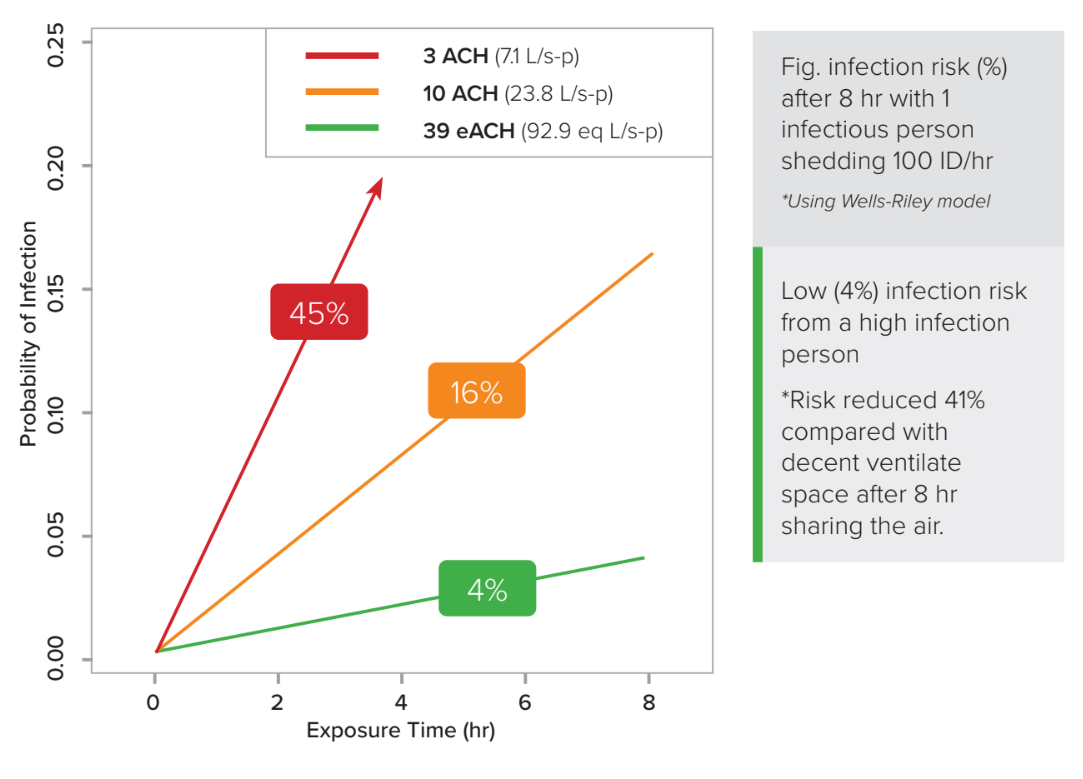
Under the direction of Dr. Jacob Bueno de Mesquita, Associate Professor of Public Health, the team assessed Visium Far-UVC fixtures in a 572 sq. ft. classroom. Using the Wells-Riley model, their analysis found a substantial reduction in modeled infection risk when Far-UVC was applied.
THE STUDY
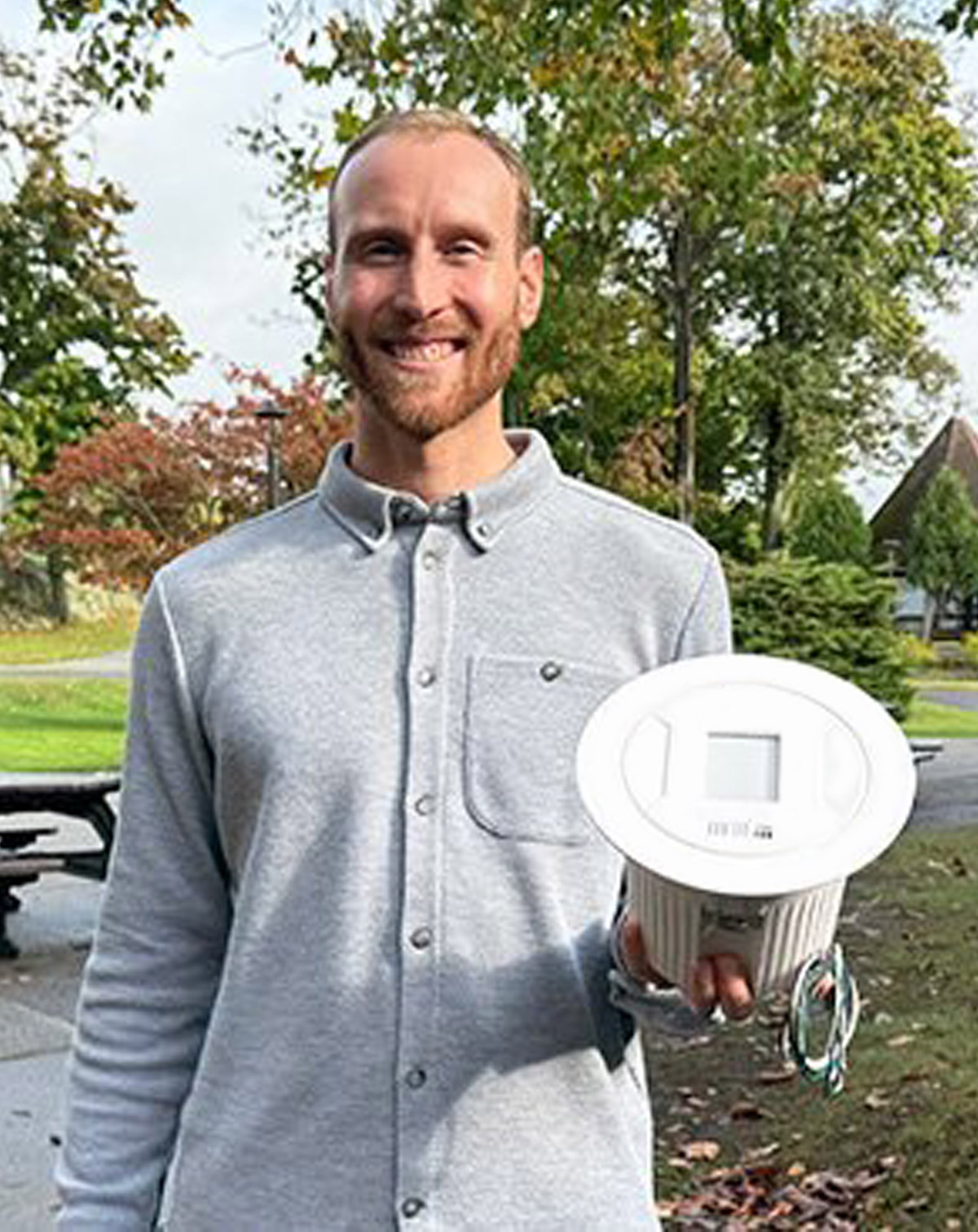
The scenario modeled an 8-hour exposure period in a classroom containing an infectious “super-shedder”—someone emitting a high concentration of viral particles. Four ceiling-mounted Visium fixtures ran continuously throughout the day. To evaluate occupant exposure to Far-UVC (222 nm), students used colorimetric dosimeters and radiometers.
THE RESULTS
Study results showed:
- 90% whole-room inactivation ofSARS-CoV-2 B in under 4 minutes
Infection risk over 8 hours:
-
- With Far-UVC: 4%
- Without Far-UVC: 45%
Visium fixtures operate silently at just 14 watts each. The four-device setup boosted the classroom’s air cleaning capacity from 3 ACH (air changes per hour) to 39 eACH (equivalent air changes per hour)
- with no added noise
- virtually no visible light
- and minimal energy consumption.
Viral Control Effectiveness
Expected rate of air cleaning => 39 eACH (avg fluence of 0.876μW/cm2
Operating the four fixtures continuously costs approximately $0.30/day.
CONCLUSION
Funded by a grant from Rhode Island INBRE for Biomedical Research Excellence, the study concluded that:
“Far-UVC mitigates viral transmission at a level unparalleled by [traditional] airflow and filtration methods and should be deployed widely.”
COMMENTARY
“This was an exciting project that demonstrated a significant estimated reduction in airborne infection risk using Visium Far-UVC fixtures,” said Dr. P. Jacob Bueno de Mesquita. “[We have demonstrated] that Visium can transform high-risk indoor environments into safer spaces.”
NEWS COVERAGE of This Installation








Partner With Us
We are actively working with new facilities that want to understand what continuous sanitization can do in their own environment.
If your organization is exploring ways to improve indoor environmental quality and reduce pathogen risk, we welcome the opportunity to collaborate. Our team will assess your space, recommend an appropriate Visium solution, and support your deployment to help generate real world results tailored to your facility.