
Upper-Room UVC vs Far-UVC:
Which UV Approach Is Right for Your Space?
Visium Far-UVC Technology is a continuous biosecurity system that treats the entire room with germicidal light — not just the air near the ceiling.
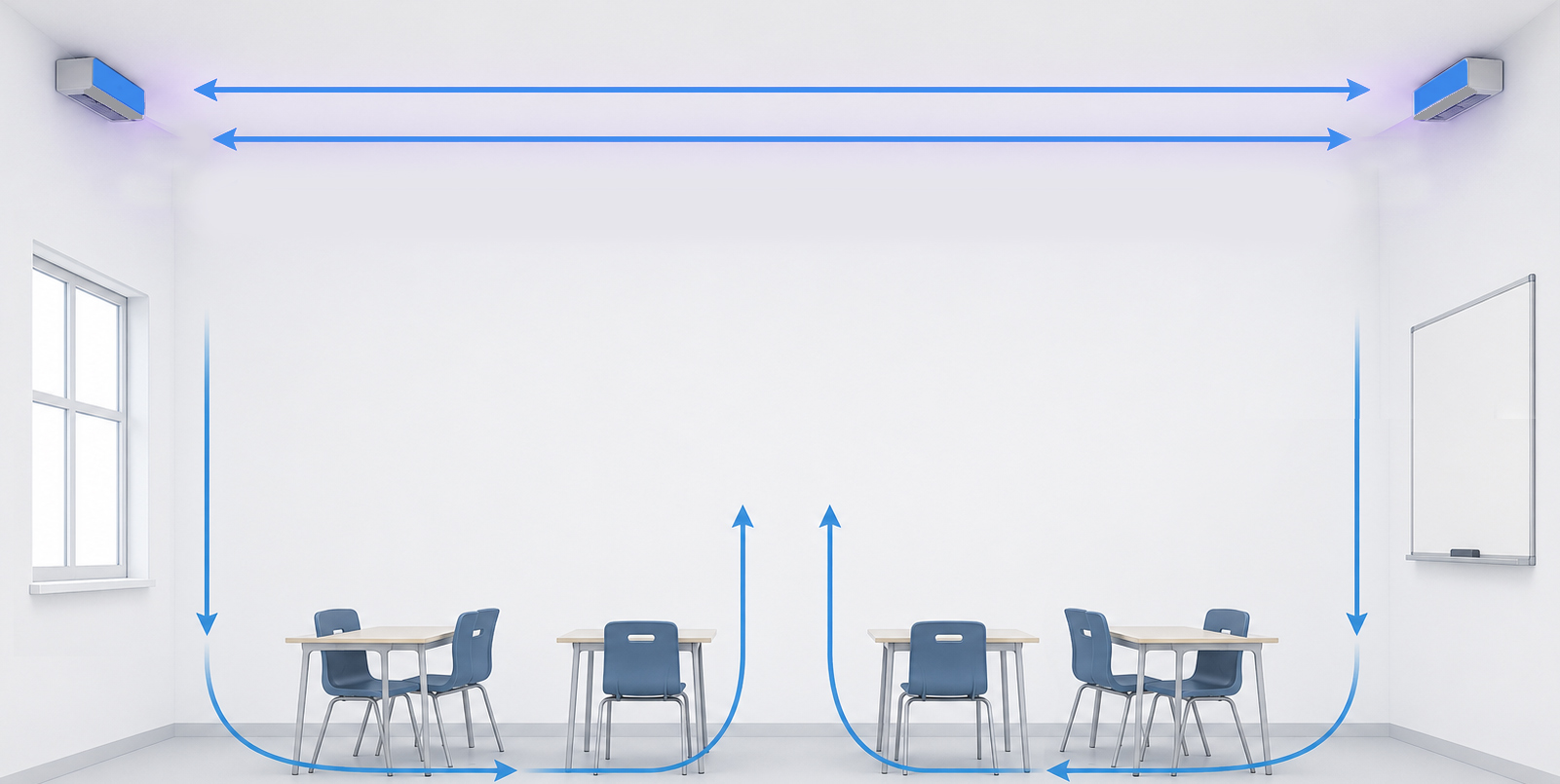
Upper-room germicidal UV has been used since the 1930s. It works by shooting germicidal UV light upward toward the ceiling where it can’t reach people’s eyes. Air rises up through that zone, gets cleaned, and falls back down. Smart — but it depends on air actually moving up and down. Low ceilings, air conditioning, or bad airflow and the whole system underperforms. Visium Far-UVC uses a different wavelength that’s safe for the entire room — not just the upper zone. The light goes everywhere. People can be anywhere.
Upper-room GUV has been used in tuberculosis control since the 1930s and is CDC-endorsed for TB prevention in high-risk settings. It’s a proven technology with decades of data behind it — but it operates on different principles than Far-UVC and carries constraints that limit applicability in modern commercial and institutional spaces.
Related:
→ The Science of Far-UVC
→ Visium Use Cases by Industry
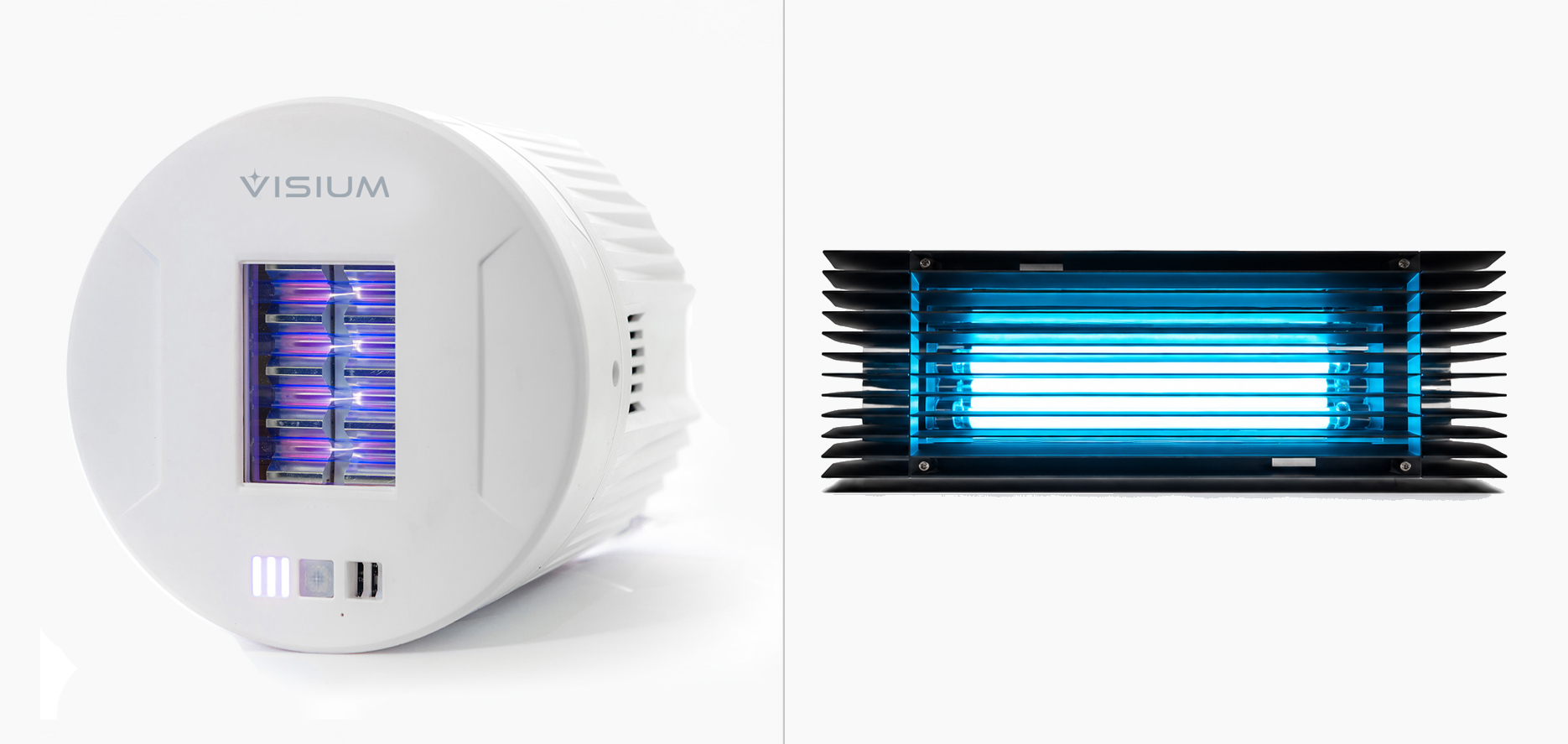
How Upper-Room UV Works
Upper-room GUV fixtures mount on walls near the ceiling, using louvers or shields to direct 254nm germicidal UV upward into the space above approximately 7–8 feet.
Room air rises through convection into this upper UV zone, pathogens are inactivated, then clean air circulates back into the occupied lower zone.
The process is indirect: pathogens must travel upward into the treatment zone to be inactivated. This reliance on vertical air mixing is both the technology’s strength and its primary limitation.
The Airflow Dependency Problem
Upper-room UV efficacy is highly sensitive to vertical air mixing:
- Low ceilings (<9 feet): UV zone is compressed, reducing treatment volume and increasing hazard risk if someone stands on elevated surfaces
- Ceiling fans or downward-blowing diffusers: can disrupt the critical upward air movement needed to carry pathogens through the treatment zone
- Air-conditioned spaces with stratified temperature layers: reduced natural convection means less vertical mixing
Visium Far-UVC treats the entire room volume directly. Pathogens don’t need to travel anywhere. Efficacy is substantially less dependent on room geometry or airflow patterns.
Performance Comparison
| Performance Factor | Upper-Room UVC | Visium Far-UVC |
|---|---|---|
| Room coverage | Upper zone only; airflow-dependent for lower zone | Entire room volume |
| Efficacy in low-ceiling rooms | Reduced — limited treatment volume | Full — ceiling height minimally affects airborne performance |
| eACH (typical installation) | 3–10 eACH (varies with airflow) | Up to 184 eACH* |
| TB reduction data | Strong historical evidence | Not yet specifically studied |
| COVID/influenza reduction | Effective (airflow dependent) | ✓ Highly effective (room-scale studies) |
| Installation complexity | High — aiming and shielding critical | Low — ceiling mount, no aiming required |
| Ongoing safety monitoring | Periodic louver inspection required | Annual lamp output verification |
Safety Profile Comparison
| Safety Factor | Upper-Room UVC (254nm) | Visium Far-UVC (222nm) |
|---|---|---|
| Safe for eyes (direct exposure) | ✗ Photokeratitis risk if misaimed | ✓ Does not penetrate tear film |
| Safe for skin (extended) | ✗ Erythema risk in UV zone | ✓ Does not penetrate stratum corneum |
| Ceiling height requirement | Minimum 7', however minimum 9' is recommended | Diffuse Lens – 7'4" minimum Clear Lens – 9'4" minimum |
| Shield/louver maintenance | Required — misalignment is hazardous | ✓ Not required |
| Can remain active during maintenance | ✗ Must be deactivated | ✓ Yes (222nm only) |
Which UVC Solution Is Right for Your Application?
| Application | Recommended Approach | Notes |
|---|---|---|
| TB clinic / high-ceiling shelter | Either — Upper-Room GUV or Far-UVC | Upper-Room GUV has historical validation; Far-UVC simpler to install |
| Standard office / classroom (8–10 ft) | Far-UVC preferred | Upper-Room GUV has limited treatment zone at low ceiling heights |
| Healthcare waiting room | Far-UVC preferred | Safety profile and silent operation ideal for clinical settings |
| Warehouse / high bay (>14 ft) | Either; Far-UVC pendant scales well | Far-UVC high-bay fixtures purpose-built for this |
| Quick retrofit | Far-UVC preferred | No aiming, shielding, or airflow analysis required |
FAQs
Is upper-room UV proven to reduce disease transmission?
Yes — upper-room UV has the strongest historical evidence base of any UV approach for occupied spaces, particularly for tuberculosis. For non-TB respiratory pathogens, evidence is more limited but supportive.
Why is Far-UVC gaining favor for new installations?
Three reasons: Far-UVC’s safety profile eliminates careful aiming and shielding requirements; it works in any ceiling height; and it treats the entire room volume rather than relying on vertical air mixing.
Can upper-room UV and Far-UVC be installed in the same space?
Technically yes, but there’s rarely a compelling reason to layer both UV technologies. If you have upper-room UV already installed, Far-UVC could supplement rooms where ceiling height or airflow limits upper-room GUV performance.
Sources: CDC Guidelines for Preventing M. tuberculosis Transmission (2005) | Nardell EA, et al. IUATLD (2021) | Welch D et al., Scientific Reports (2022) | WHO Guidelines on TB Infection Control (2009)