
Far-UVC vs Traditional UVC:
What’s the Difference and Why It Matters
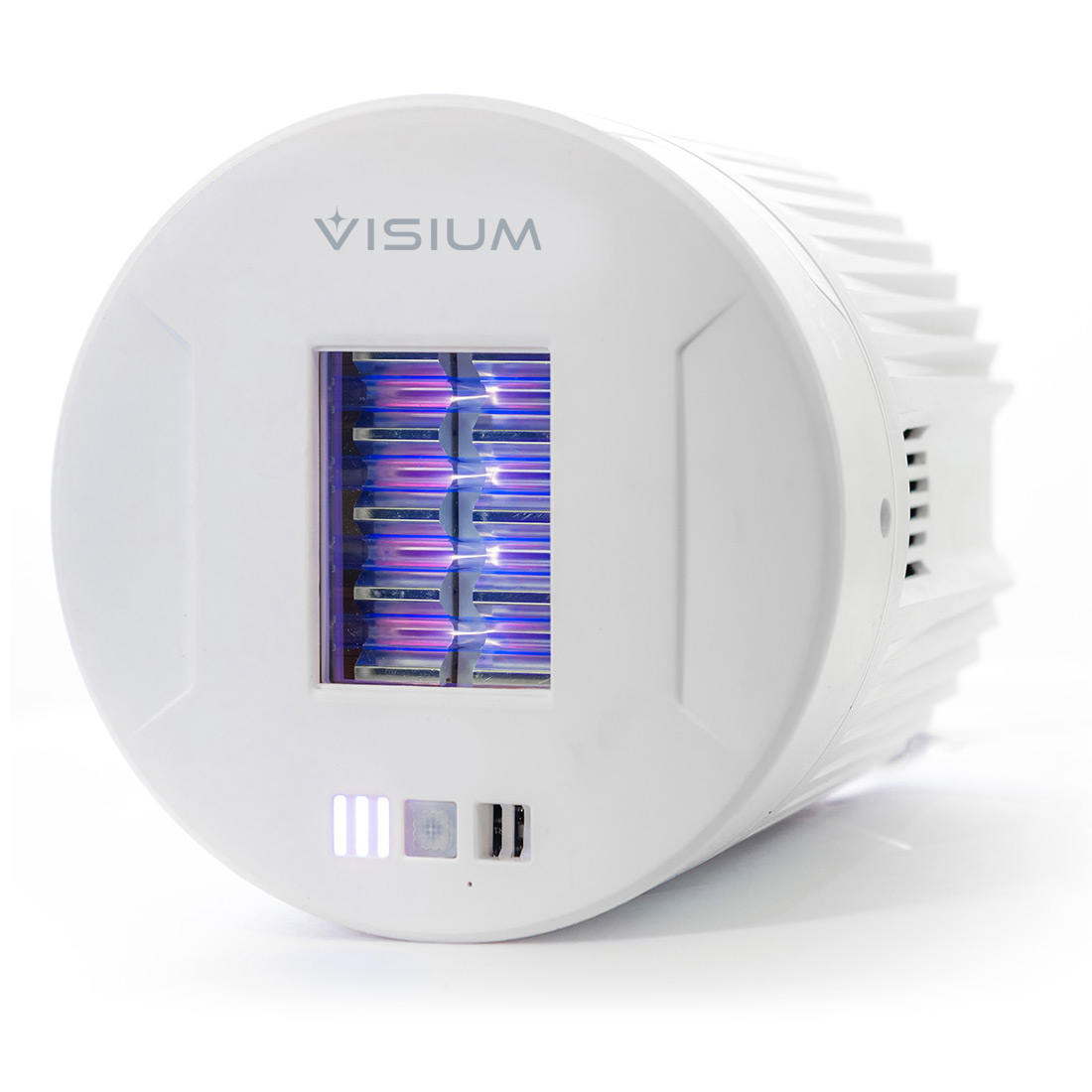
Visium Far-UVC Technology is a continuous biosecurity system that uses a safe wavelength of ultraviolet light — 222 nanometers — to destroy airborne viruses and bacteria while people are in the room.
You’ve probably heard that UV light inactivates viruses and bacteria — that’s been true for over 100 years. The problem was it also could hurt people’s eyes and skin, so it was only used in empty rooms or unoccupied spaces. Visium figured out how to use a specific wavelength — 222nm — that destroys viruses and bacteria but physically cannot reach the living cells in your eyes or skin. Same germ-killing power. Safe for occupied spaces. That’s the entire difference.
Germicidal ultraviolet light has disinfected water, surfaces, and air for over a century. But there’s a critical distinction reshaping Infection Control procedures in occupied buildings: not all UV light is the same. Traditional germicidal UVC (254nm) is highly effective — and highly hazardous to human tissue. Far-UVC at 222nm is equally effective against pathogens and safe for continuous human exposure.
Related:
→ The Science of Far-UVC
→ Visium Use Cases by Industry
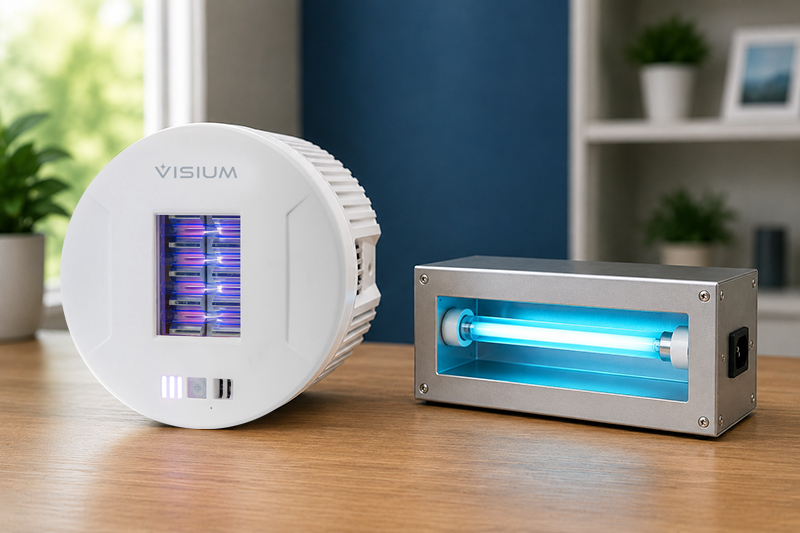
The UV Spectrum at a Glance
| UV Type | Wavelength | Inactivate Pathogens? | Safe While Occupied? | Common Sources |
|---|---|---|---|---|
| UVA | 315–400nm | Limited | ✓ Yes | Sunlight, black lights |
| UVB | 280–315nm | Minimal | Partial (sunburn risk) | Sunlight |
| UVC | 200–280nm 254nm Hg Lamps | ✓ Highly effective | ✗ Not for direct exposure; upper-room GUV only | Mercury lamps |
| Far-UVC | 200–230nm 222nm KrCl Lamps | ✓ Highly effective | ✓ Yes | KrCl excimer lamps |
Why Traditional UVC Cannot Be Used Where People Are Present
Conventional 254nm germicidal lamps are highly effective — but direct exposure causes photokeratitis (a painful eye injury like snow blindness) and skin burns within minutes. The NIOSH permissible exposure limit for 254nm UV is just 6 mJ/cm² for an 8-hour workday.
This means traditional UVC only runs in empty spaces — between patient visits, overnight in vacant offices, or aimed at the ceiling. The moment people return, sanitization stops. That’s a critical gap: transmission risk is highest during occupancy, not when everyone’s gone.
The Core Distinction
Traditional UVC: safe for empty rooms and spaces. Far-UVC 222nm: safe for occupied rooms. For continuous, real-time pathogen reduction where people are present, only Far-UVC can be used.
Why Far-UVC Closes That Gap
At 222nm, UV photons are absorbed in the outermost dead-cell layer of human skin (the stratum corneum) and the tear film of the eye — neither contain living cells that can be damaged. Microbes, however, are 20-100 times smaller than a human cell. The same wavelength penetrates and destroys them entirely.
| Factor | Traditional UVC (254nm) | Far-UVC (222nm) |
|---|---|---|
| Safe while occupied | ✗ Not for direct exposure; upper-room GUV only for occupied spaces | ✓ Yes (filtered lamps, ACGIH limits) |
| Germicidal efficacy | Highly effective | Equivalent — peer-reviewed |
| Direct, continuous operation | ✗ Only between occupancy | ✓ Yes — 24/7 if needed |
| Eye safety | ✗ Photokeratitis risk | ✓ Does not penetrate tear film |
| Skin safety | ✗ Erythema risk | ✓ Does not penetrate stratum corneum |
| Real-time pathogen reduction | ✗ Gaps during occupancy | ✓ Continuous |
| Technology maturity | 100+ year track record | ~10 years peer-reviewed data |
| Ozone generation | No ozone generation | Minimal (filtered KrCl) |
Source: Brenner DJ, et al. (2017). Far-UVC light: A new tool to control the spread of airborne-mediated microbial diseases. Scientific Reports.
What the Research Shows on 222nm Efficacy
H1N1 influenza (aerosolized): >99.9% inactivation at 2 mJ/cm² (Buonanno et al., 2017)
Human coronaviruses 229E and OC43: 99.9% inactivation at 1.2–1.7 mJ/cm² (Buonanno et al., 2020)
MRSA (S. aureus): Effective inactivation in room-scale study (Welch et al., 2022)
Room-scale aerosolized pathogen: 98.4% reduction using 5 fixtures at 184 eACH* (Welch et al., 2022)
* 184eACH was measured with aerosolized Staphylococcus aureus.in a room sized chamber. Eadie, et al. Far-UVC (222nm) efficiently inactivates an airborne pathogen in a room-sized chamber. Nature Scientific Reports, 2022.
Sources: Scientific Reports (2017, 2020, 2022)
FAQs
Is Far-UVC as effective as traditional UVC at killing pathogens?
Yes. Peer-reviewed studies show equivalent germicidal efficacy between Far-UVC (222nm) and traditional UVC (254nm) at comparable doses. The advantage of Far-UVC is achieving this safely in occupied spaces.
Why hasn't traditional UVC been replaced by Far-UVC already?
Far-UVC technology has only become commercially available at scale within the last decade. Traditional UVC has a century of established use. Adoption of Far-UVC is accelerating rapidly following COVID-19 and the expansion of peer-reviewed safety data.
Does Far-UVC produce ozone?
Well-designed filtered KrCl excimer lamps produce minimal ozone — significantly less than unfiltered lamps or some traditional UV sources. Visium fixtures use optical filtration to eliminate harmful longer-wavelength emissions.
Sources: Buonanno M et al., Scientific Reports (2017, 2020) | Eadie et al., Scientific Reports (2022) | Brenner DJ et al. (2022) | ACGIH TLV Documentation | NIOSH UV Exposure Limits