
Far-UVC vs Portable Air Purifiers:
Coverage, Noise, and Real-World Performance
Visium Far-UVC Technology is a continuous biosecurity system installed at the ceiling that treats the entire occupied space—not just the air that passes through a machine on the floor.
A portable air purifier is like a vacuum for germs: it sucks in nearby air, filters it, and blows it back out. That works — but only for air that actually passes through it. The other side of the room, the corner by the window, the air someone just exhaled two feet from the purifier — none of that gets treated until it happens to drift toward the machine. Visium mounts at the ceiling and uses light to inactivate pathogens throughout the entire room simultaneously. No spot-treatment. No dead zones. No noise.
Portable air purifiers saw massive demand during COVID-19 and remain popular for offices, classrooms, and healthcare waiting areas. They’re accessible, require no installation, and provide measurable air quality improvement. But they come with limitations that matter in infection control: spatial coverage, noise, and the fundamental constraint of being a single-point device in a multi-point pathogen emission environment.
Related:
→ The Science of Far-UVC
→ Visium Use Cases by Industry
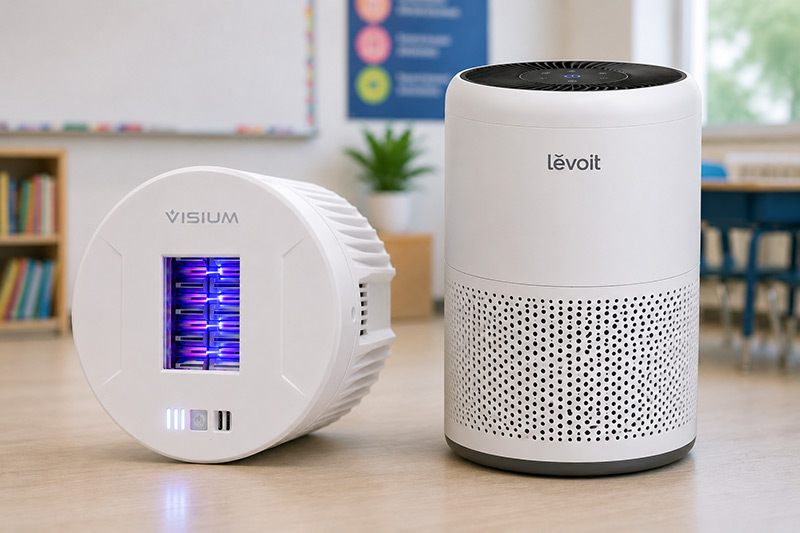
The Core Limitation of Any Point-Source Purifier
A portable purifier cleans the air that passes through it. In a well-mixed room, this is reasonably effective. In a real room — with furniture, partitions, people clustered at tables — purification is uneven. Studies measuring actual risk reduction in classroom settings have found that while average particle counts decrease, near-source exposure remains largely unchanged unless the purifier is very close to the infectious source.
Visium Far-UVC acts on pathogens throughout the entire room volume simultaneously. No single point of treatment, no dead zones, no dependence on air moving toward a device.
| Factor | Portable HEPA Purifier | Visium Far-UVC Fixture |
|---|---|---|
| Coverage area | 150–500 sq ft per unit (typical) | ~100–400 sq ft per fixture |
| Treats entire room volume | ✗ Point-source only | ✓ Whole room |
| Effective eACH | 2–5 eACH per unit in range | Up to 184 eACH* |
| Noise level | 30–55 dB (fan) | ✓ Silent |
| Installation | ✓ Plug-in, no install | Ceiling mount, hard-wired |
| Surface pathogen inactivation | ✗ No | ✓ Yes (limited) |
| Removes dust / PM2.5 | ✓ Yes | ✗ No |
| Works around furniture obstacles | ✗ Reduced by obstructions | ✓ Largely unaffected |
| Energy use | 50–100W per unit | ~25–60W per fixture |
| Replacement cost | Filter: $50–$150/yr per unit, every 6 months | Lamp: ~$400 per 10,000 hrs of use (~14 months continuous) |
Noise: The Hidden Problem in Schools and Clinics
Portable HEPA purifiers at high speed generate 45–55 dB of fan noise — comparable to a quiet conversation. In classrooms, teachers raise their voices; audio-dependent learners are disadvantaged; units get switched to low (reduced effectiveness) or turned off entirely during instruction.
In clinical settings, continuous fan noise masks patient communication and adds to ambient stress. In corporate offices, noise complaints are among the most common reasons portable purifiers are underutilized.
Visium Far-UVC operates with no sound. Full effectiveness regardless of the noise sensitivity of the space.
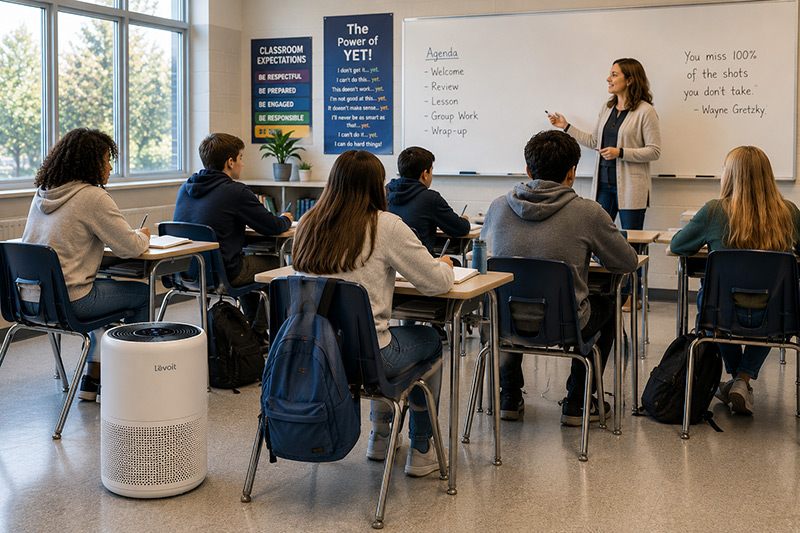
Classroom Scenario
A typical 900 sq ft classroom would require 2–3 properly sized HEPA purifiers running at high speed to achieve meaningful eACH — with continuous fan noise, floor space consumed, and periodic filter changes. Two Visium Far-UVC ceiling fixtures provide comparable or superior pathogen reduction: silent, permanent, no floor footprint.
FAQs
How many portable purifiers would I need to match one Far-UVC fixture?
In a 600 sq ft room, a well-sized HEPA unit might achieve 4–5 eACH for air that passes through it. A single Far-UVC fixture provides significantly higher effective eACH for airborne pathogen inactivation across the full volume. Multiple fixtures scale the effect further.
Can I use both portable HEPA purifiers and Far-UVC in the same space?
Yes — and this is often the best approach. Portable HEPA addresses particulates, allergens, and PM2.5 that Far-UVC doesn’t remove. Far-UVC handles real-time pathogen inactivation room-wide. Together they provide more comprehensive protection than either alone.
Do portable air purifiers help with COVID-19 and other respiratory viruses?
Yes — well-sized HEPA purifiers running at adequate speed do reduce airborne virus concentrations. The limitation is spatial coverage and the point-source constraint. They are a valuable tool, not a complete solution.
Sources: Sims NE et al. (2022) Indoor Air | Corsi RL et al. (2021) Corsi-Rosenthal Box Studies | Welch D et al., Scientific Reports (2022) | CDC Clean Air in Buildings Challenge Technical Resources
A Note on Portable UV-C Purifiers
Some portable purifiers incorporate UV-C lamps (254nm) inside the unit housing. Pathogens passing through the UV chamber are exposed safely — this is a legitimate approach. But it’s fundamentally different from room-wide Far-UVC treatment. Only the air that passes through the device gets treated; pathogens in the ambient room air are not addressed until they eventually drift into the purifier.