
Far-UVC vs HVAC Filtration:
Why Your Air Handler Isn’t Enough
Visium Far-UVC Technology is a continuous biosecurity system that protects the air throughout an entire room — including every corner your HVAC system never reaches.
Your HVAC system pulls air through a filter — but only the air that actually makes it to the filter gets cleaned. Imagine a crowded classroom: one kid sneezes near the window, far from any air vent. That virus-laden air can float in the breathing zone for minutes before the HVAC system ever touches it. Visium Far-UVC fixtures sit at the ceiling and fill the whole room with a field of light that inactivates pathogens the instant they’re in the air — no waiting, no dead zones.
HVAC filtration upgrades — particularly from MERV-8 to MERV-13 — became a widely recommended COVID-19 mitigation measure. It’s a logical intervention with real benefits. But it’s also subject to significant misunderstanding about what it actually achieves in terms of real-time occupant-level protection.
Related:
→ The Science of Far-UVC
→ Visium Use Cases by Industry
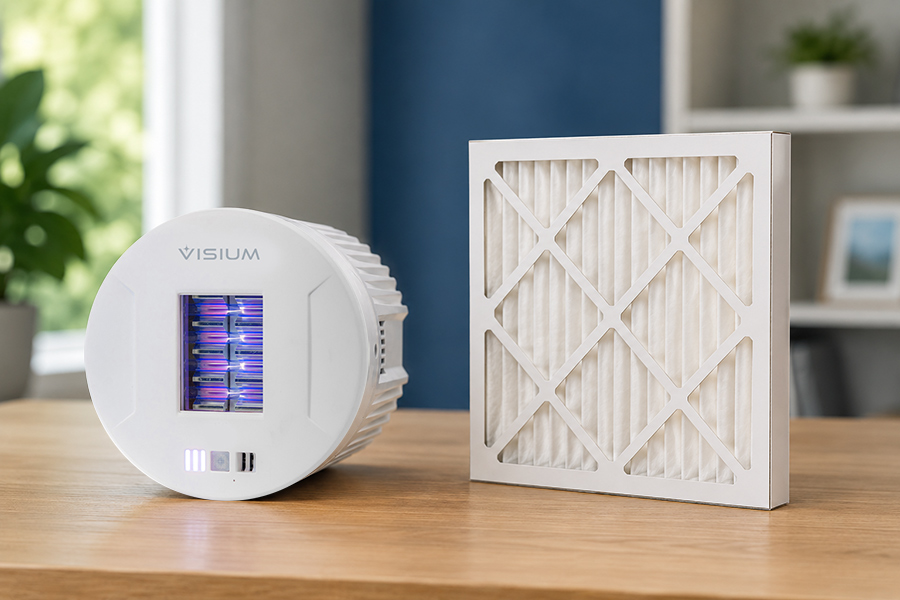
How HVAC Filtration Works for Pathogen Control
HVAC systems circulate room air through a central air handler, passing it through filters before redistribution. Higher MERV-rated filters capture smaller particles — MERV-13 captures >85% of particles in the 1–3 micron range, which covers many virus-laden aerosol droplets.
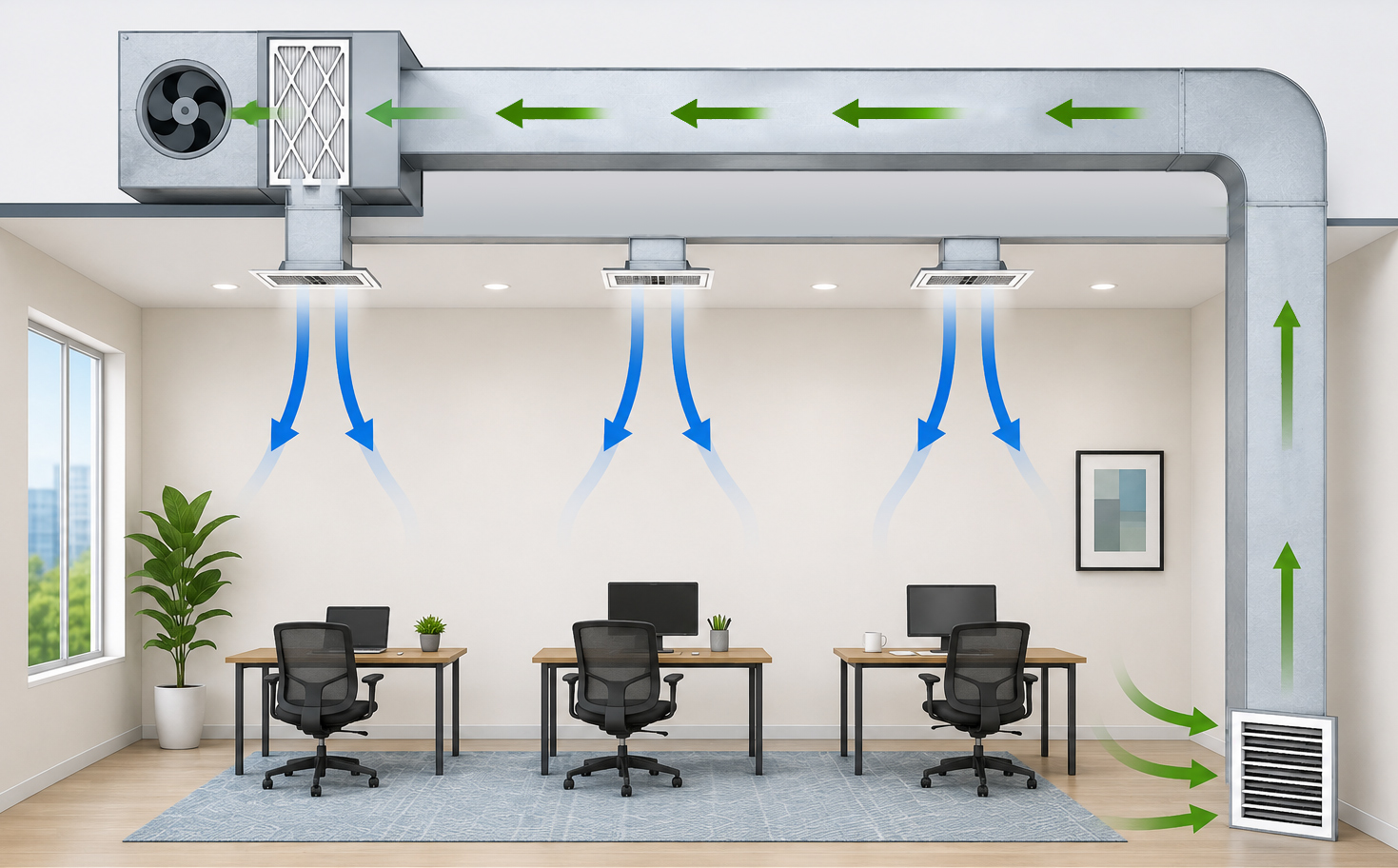
The constraint: in a typical commercial building, air passes through the HVAC system only 3–6 times per hour. Pathogen reduction is tied directly to that recirculation rate — and in most buildings it’s limited by duct capacity, fan power, and energy cost.
The Dead Zone Problem
A critically underappreciated limitation: pathogens must travel from their emission source, through the occupied zone, and into the return air pathway before they can be captured. In rooms with poor airflow distribution — corners, cubicles, spaces distant from diffusers — virus-laden aerosols can remain in the breathing zone for extended periods.
Visium Far-UVC acts on pathogens wherever they are in the room volume — the moment they’re emitted, they’re being inactivated. There is no spatial gap.
MERV Rating vs Pathogen Reduction
| MERV Rating | Particle Efficiency (1–3 micron) | eACH Added | Occupant Risk Reduction |
|---|---|---|---|
| MERV-8 (baseline) | <20% | ~0.5–1 eACH | Minimal for pathogens |
| MERV-11 | ~65% | ~1–2 eACH | Modest |
| MERV-13 | >85% | ~2–4 eACH | Moderate |
| MERV-16 / HEPA | >95% | ~4–8 eACH | Good — if airflow adequate |
| Far-UVC (5 fixtures) | N/A — inactivation, not capture | Up to 184 eACH* | Very high (room-wide) |
The Real Costs of HVAC Upgrades
Visium Far-UVC fixtures install at the ceiling. No ductwork modifications. No pressure calculations. Retrofit installation is typically measured in hours.
Higher MERV filters create greater static pressure — may require larger fans or new AHU equipment
Many older systems cannot accommodate high-efficiency filters without significant mechanical work
Increased fan power consumption raises energy costs for large commercial buildings
Filter bypass — air leaking around a filter — is common in aging systems and can significantly reduce real-world efficiency
Professional service required for filter changes in central air handlers
The Layered Approach
Best practice per ASHRAE and CDC guidance: adequate ventilation + appropriate filtration + supplemental air cleaning like Far-UVC. Each layer addresses different limitations. Far-UVC fills the critical gap of real-time, room-wide inactivation during occupancy that HVAC filtration cannot provide.
FAQs
Should I upgrade my HVAC filters or install Far-UVC?
Both, ideally. If your building runs MERV-8, upgrading to MERV-13 is a good first step. Far-UVC then adds real-time room-wide inactivation that filtration cannot provide on its own. In high-occupancy, high-risk spaces, Far-UVC provides higher eACH and broader spatial coverage.
Can Far-UVC be integrated with my existing HVAC system?
Far-UVC fixtures are standalone ceiling-mounted devices that don’t require HVAC integration. They complement your existing ventilation and filtration without ductwork modifications.
What MERV rating replicates Far-UVC performance?
There is none. MERV-16/HEPA systems with very high airflow might approach 8–10 eACH. Published Far-UVC room studies demonstrate up to 184 eACH*. The gap reflects the difference between filtering air through a device vs. inactivating pathogens throughout the entire room volume.
Sources: ASHRAE Standard 62.1-2022 | Welch D et al., Scientific Reports (2022) | CDC Ventilation Guidance (2021) | EPA HVAC Filtration Technical Brief