
Visium Far-UVC vs HEPA Filtration:
Which Works Better for Airborne Pathogen Control?
Visium Far-UVC Technology is a continuous biosecurity system that silently kills airborne germs using a special wavelength of light — while people are still in the room.
Think of it like this: HEPA filtration is a net. It captures particles that can carry bacteria and viruses, but only the ones that float into the filter. Visium Far-UVC uses a specific wavelength of ultraviolet light (222 nanometers) that continuously inactivates bacteria and viruses the instant they float through the air — across the entire room, all the time, without anyone having to do anything.
When facilities managers and infection control specialists evaluate indoor air quality solutions, two technologies frequently appear at the top of the list: HEPA filtration and Far-UVC light. Both are scientifically validated. Both are chemical-free. But they work in fundamentally different ways — and in most real-world settings, only one of them can be continuously active while people are in the room.
Related:
→ The Science of Far-UVC
→ Visium Use Cases by Industry
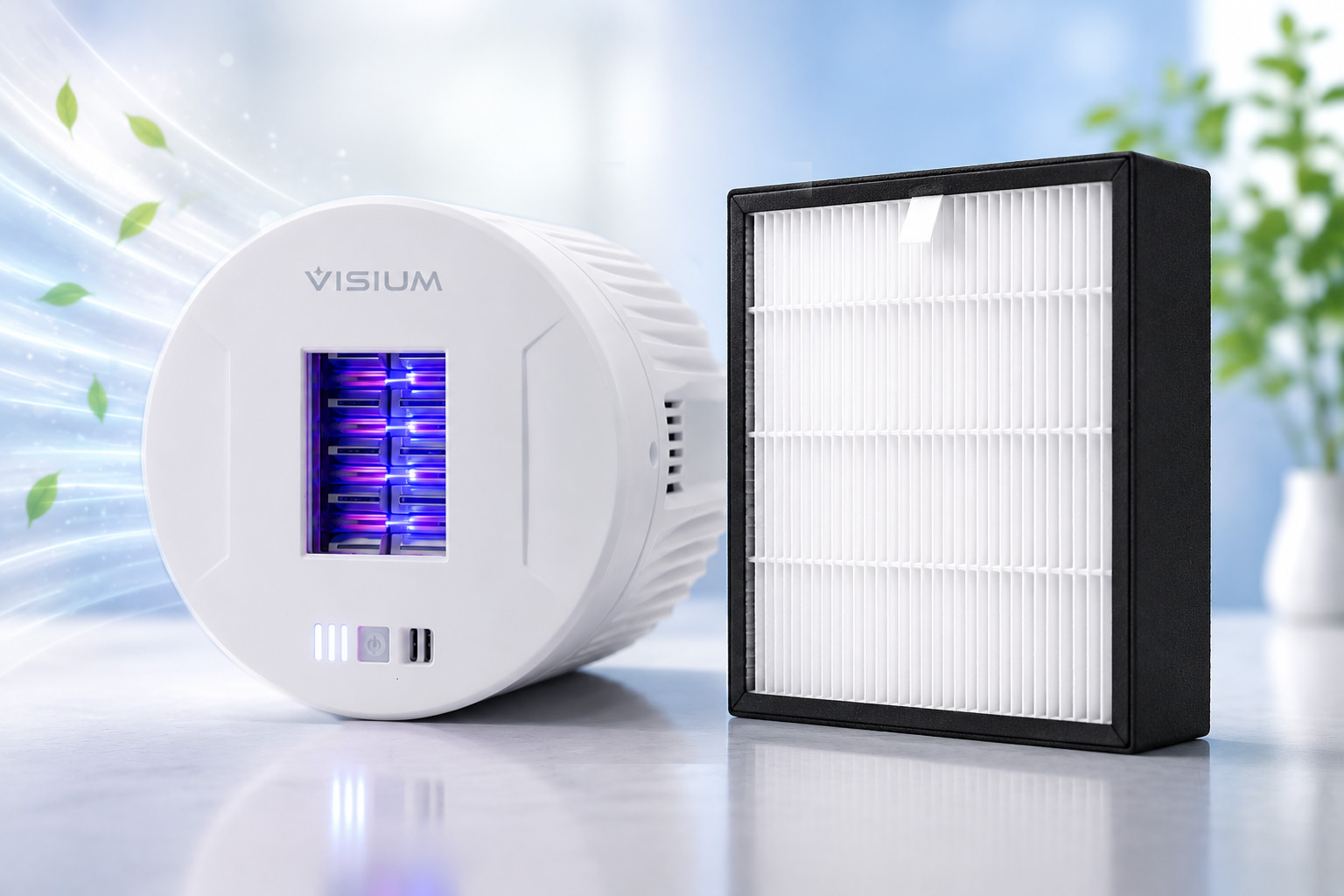
How Each Technology Works
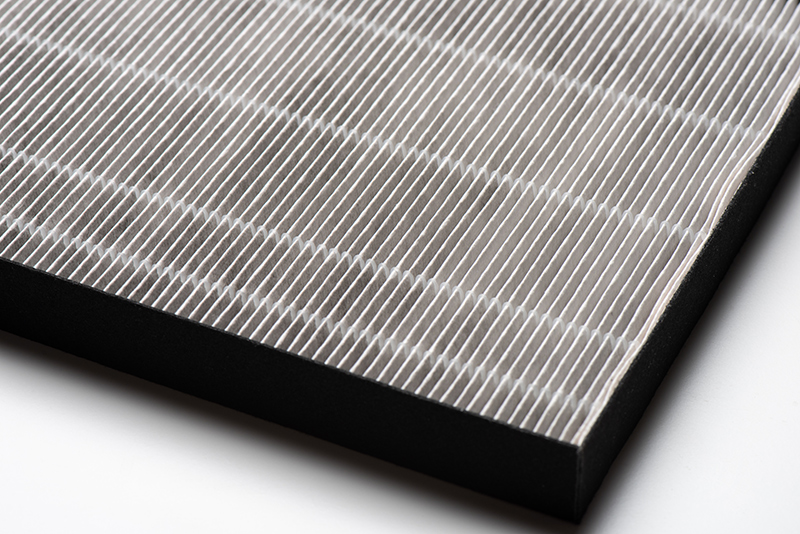
HEPA Filtration
HEPA (High Efficiency Particulate Air) filters physically capture airborne particles, including aerosols that may contain bacteria and viruses, as air passes through a dense fiber matrix. A true HEPA filter removes at least 99.97% of particles 0.3 microns or larger from the air that passes through it.
HEPA filtration can be implemented in two common ways: as part of a centralized HVAC system that treats air throughout a building, or as a portable room air cleaner that continuously recirculates air within a single space. In both cases, the key phrase is “passes through.” HEPA only cleans the air that is mechanically drawn into and through the filter.
HEPA filters do not inactivate pathogens; they capture and retain them on the filter media. Overall performance depends on how effectively air is moved through the system and how many times the room air passes through the filter each hour.
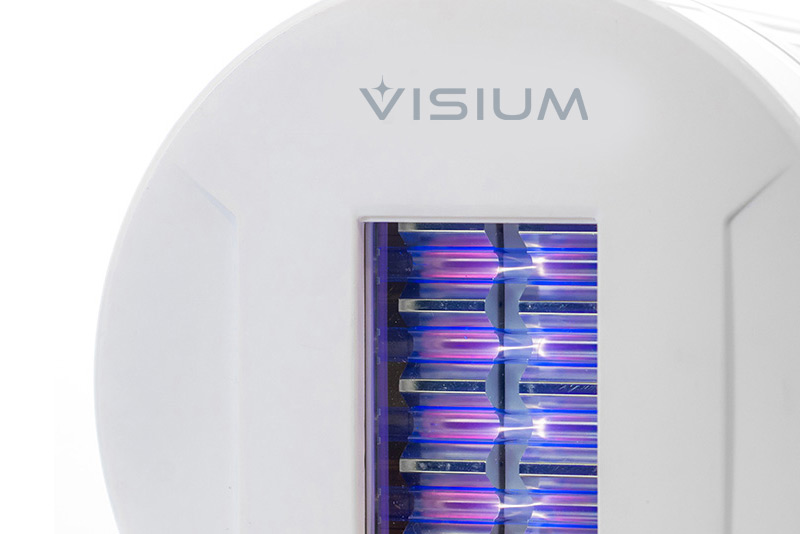
Far-UVC Light (222nm)
Far-UVC light operates at 222 nanometers — a wavelength that disrupts the RNA and DNA of airborne pathogens, inactivating them within the air column itself. Unlike conventional germicidal UV (254nm), 222nm far-UVC cannot penetrate human skin or eye tissue, making it safe for continuous use in occupied rooms.
Visium fixtures mount at the ceiling and emit a continuous photon field throughout the room. Pathogens don’t need to flow through a device — they’re inactivated where they float, in every corner of the room.
Source: Buonanno M, et al. (2022). Scientific Reports. | Welch D, et al. (2022). Nature Scientific Reports.
Performance Comparison
| Factor | HEPA Filtration | Far-UVC (222nm) |
|---|---|---|
| Primary mechanism | Physical capture | Photonic inactivation |
| Works while occupied | ✓ Yes | ✓ Yes |
| Treats entire room volume | ✗ Only what passes through filter | ✓ Whole room |
| Airborne virus reduction | 99.97% of filtered particles | 99.8% in room-scale studies |
| eACH equivalent (typical) | 2–6 eACH | Up to 184 eACH |
| Sanitizes surfaces | ✗ No | ✓ Yes (limited range) |
| Removes dust, allergens | ✓ Yes | ✗ Not primary function |
| Noise level | Moderate (fan) | ✓ Silent |
| Works in poor-airflow zones | ✗ Limited | ✓ Yes |
| Maintenance | Filter replacement 6–12 months | Annual lamp assessment |
* 184eACH was measured with aerosolized Staphylococcus aureus.in a room sized chamber. Eadie, et al. Far-UVC (222nm) efficiently inactivates an airborne pathogen in a room-sized chamber. Nature Scientific Reports, 2022.
The eACH Advantage Explained
Equivalent Air Changes per Hour (eACH) is the standard ASHRAE metric for measuring how effectively a technology reduces pathogen concentration. It puts every technology on the same scale. A 2022 study in Scientific Reports showed five Far-UVC fixtures produced 184 eACH — reducing steady-state pathogen load by 98.4%. To match that with HEPA alone, you’d need an extremely high-flow central system or dozens of portable units.
Source: Eadie, et al. Far-UVC (222nm) efficiently inactivates an airborne pathogen in a room-sized chamber. Nature Scientific Reports, 2022.
Cost Comparison
| Cost Factor | HEPA Portable (~1,000 sq ft) | Far-UVC Fixture (per room) |
|---|---|---|
| Capital cost | $300–$800 per unit | $1,000–$2,000 per fixture |
| Ongoing maintenance | Filters: $50–$150/yr | Lamp: varies by brand |
| Energy (annual) | $60–$150/yr per unit | $20–$60/yr per fixture |
| Installation | Plug-in | Ceiling mount (minimal) |
Limitations of Each Approach
HEPA Limitations
- Only cleans air that physically passes through the unit — dead zones with limited airflow stay contaminated
- Portable units must be correctly sized to the room; undersized units give false assurance
- Saturated filters can harbor microbial growth if not replaced on schedule
- Does not address surface contamination
- Fan noise is disruptive in clinical, educational, or quiet spaces
Far-UVC Limitations
- Does not remove particles from air — does not replace filtration for PM2.5 or allergen control
- Efficacy can be reduced by shadowing from furniture or ceiling obstructions
- Lamp replacement required (typically annually)
Key Insight
HEPA and Far-UVC are complementary, not competing. HEPA removes particulate matter. Far-UVC inactivates pathogens. Best-practice infection control layers both — and Far-UVC provides the only continuous, room-wide pathogen inactivation that works while people are present.
FAQs
Can Far-UVC replace HEPA filters entirely?
For pathogen inactivation, Far-UVC is more effective in occupied rooms. But HEPA still removes particles, allergens, and PM2.5 that Far-UVC does not address. The two technologies are complementary.
Is HEPA or Far-UVC better for hospitals?
Healthcare facilities benefit most from a layered approach. HEPA/ULPA filtration is standard in surgical suites and isolation rooms, but adding Far-UVC is an important supplement to address pathogens in the air and on surfaces in real time. Far-UVC is ideal for all occupied spaces in the healthcare environment where continuous, hands-free pathogen reduction is critical.
How many eACH does a HEPA filter provide?
A well-sized portable HEPA unit typically provides 2–6 eACH. Compare that to 184 eACH demonstrated in published Far-UVC room-scale studies. The gap is significant in high-risk environments.
Does Far-UVC work on bacteria as well as viruses?
Yes. Far-UVC’s germicidal mechanism is effective against a broad spectrum including bacteria, viruses, and fungal spores. Published research covers S. aureus, H1N1 influenza, SARS-CoV-2, and human coronaviruses.
Sources: Welch D et al., Scientific Reports (2022) | Buonanno M et al., Scientific Reports (2020) | Brenner D et al., Photochemistry and Photobiology (2022) | ASHRAE Standard 62.1-2022