

RESEARCH REPORT
Visium Far-UVC Devices Dramatically Reduce Infection Risk Across Diverse Environments
Quantitative risk modeling completed at the University of Arizona allows for visualization of real-world impacts for Far-UVC light
Reducing the number of airborne pathogens indoors directly lowers the health risk to building occupants. While microbes can enter from outdoor air and other sources, people themselves are the primary source of indoor pathogens—a logical conclusion, since humans are the intended hosts. When a sick person talks, coughs, or even breathes, they release potentially infectious particles into the surrounding air. The likelihood that another person will inhale these particles and become infected is known as transmission risk.
One of the most effective ways to reduce transmission risk is by lowering the concentration of pathogens in the air [1, 2]. Far-UVC light does exactly that—it inactivates airborne microbes at the source [3-6], significantly decreasing the chance of infection for others in the room [2, 7, 8]. This reduction in risk can be quantified, helping decision-makers evaluate how interventions like Far-UVC improve health outcomes in shared environments.
Understanding how airborne diseases spread indoors is essential for protecting public health, especially in high-risk settings such as classrooms, offices, healthcare facilities, and public transportation. The Wells-Riley equation is a widely recognized tool used to estimate infection risk from airborne pathogens like influenza, tuberculosis, and SARS-CoV-2. By modeling key factors—ventilation rates, pathogen infectivity, duration of exposure, and number of occupants—it helps quantify how different strategies affect transmission risk[9]. Assuming good air mixing and steady-state conditions, the Wells-Riley model allows users to compare relative risks under various scenarios. It provides a powerful framework for designing safer indoor environments and supports data-driven decisions around interventions such as enhanced ventilation, air filtration, occupancy limits—and the use of Far-UVC.
EVALUATION
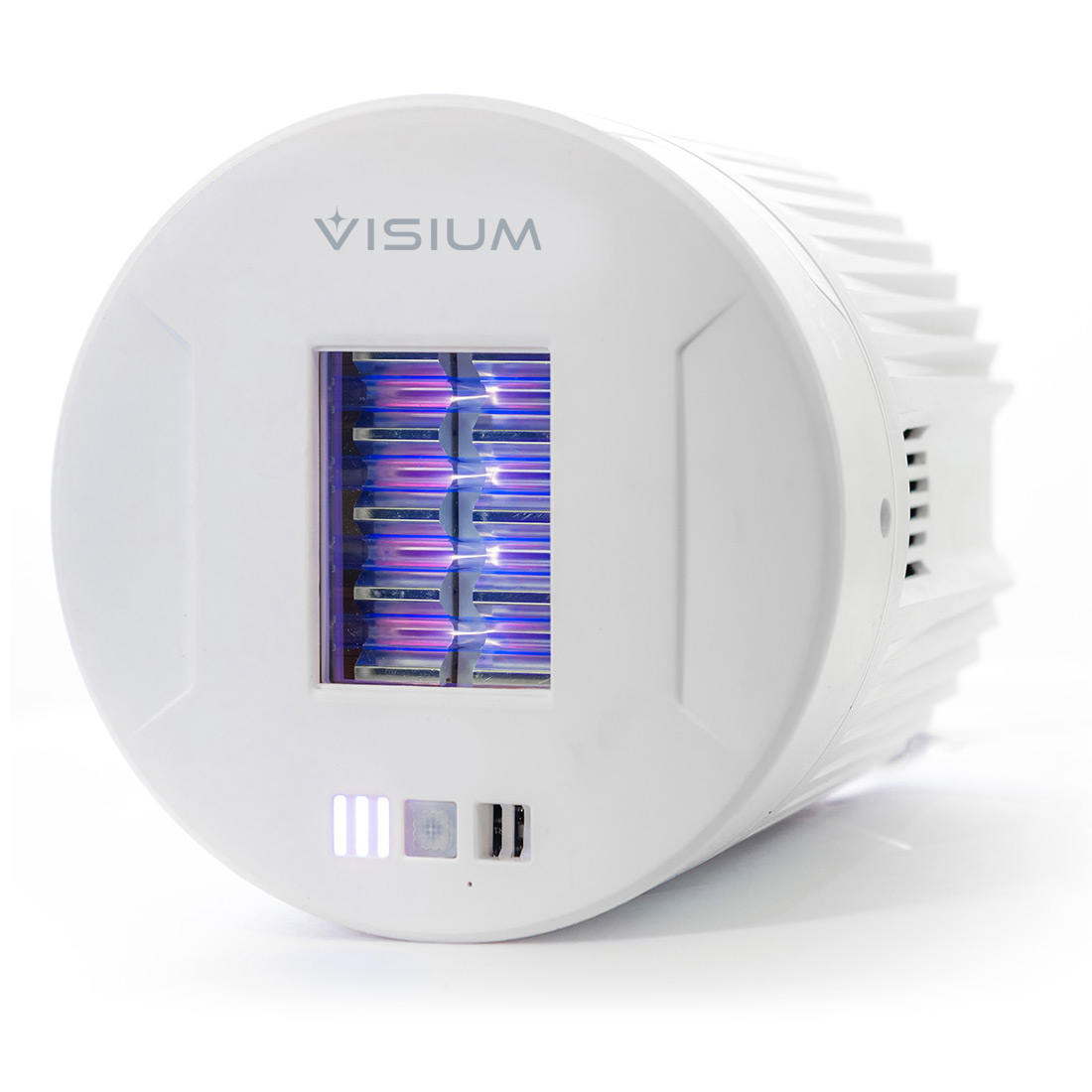
To evaluate the real-world impact of Far-UVC, a Quantitative Microbial Risk Assessment (QMRA) was conducted across four common indoor environments, common pathogens, and in two different occupancy scenarios. The Visium Far-UVC device is attached to ceilings and directs 222nm light into rooms, inactivating pathogens in the air as they circulate within the space. In each case, Far-UVC showed measurable reductions in transmission risk—offering a scientifically backed way to make indoor air safer and support healthier shared spaces[10].
Location
- Medical Waiting Room
- Commercial Waiting Room
- Lecture Hall
- Open-plan Office
Pathogen
- H1N1 Influenza
- SARS-CoV-2
- MRSA (Staphylococcus aureus)
Scenarios
- Co-Occupying with 1 sick person
- Sitting in a room for 15 minutes after a sick person left (heretofore 15 min After)
Scroll To: Waiting Rooms Open Office Floorplans Lecture Halls
Waiting Rooms
High Ventilation
Longer turnover time
Higher pathogen risk
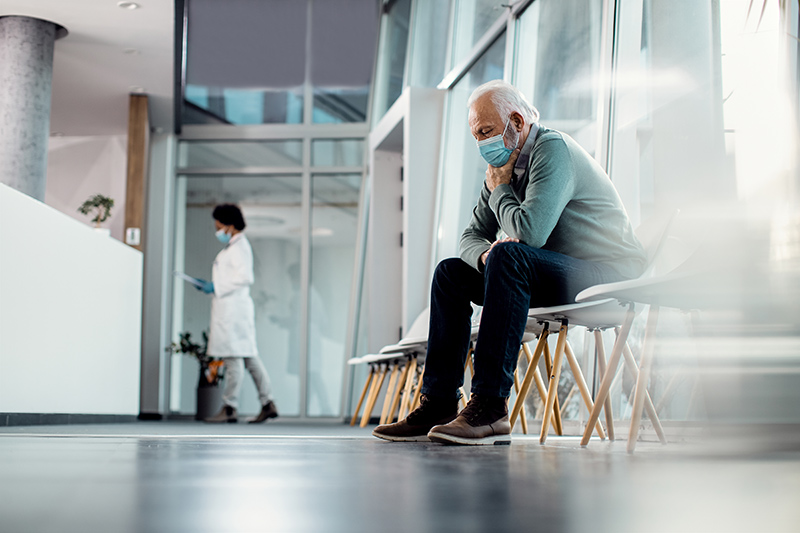
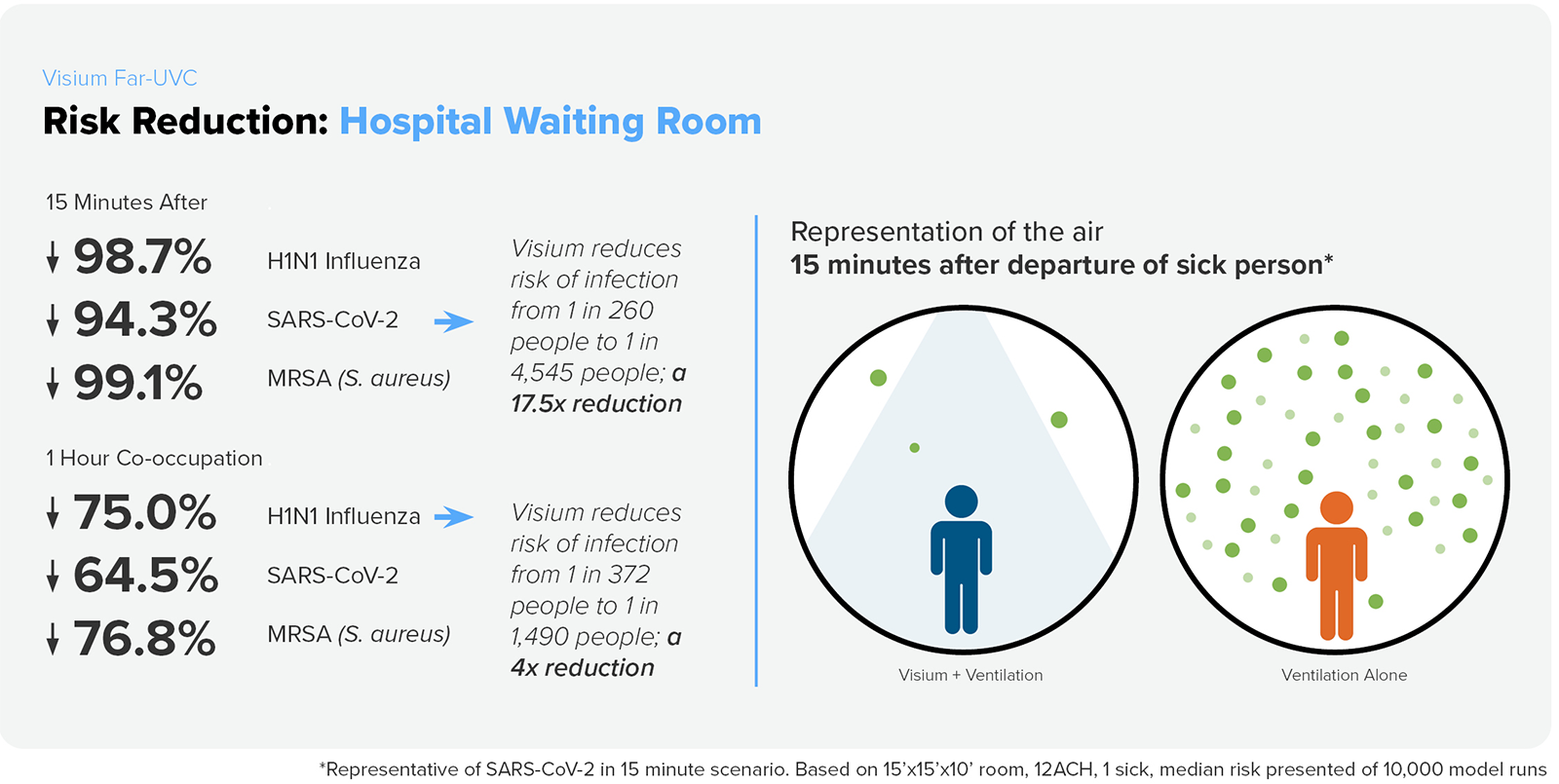
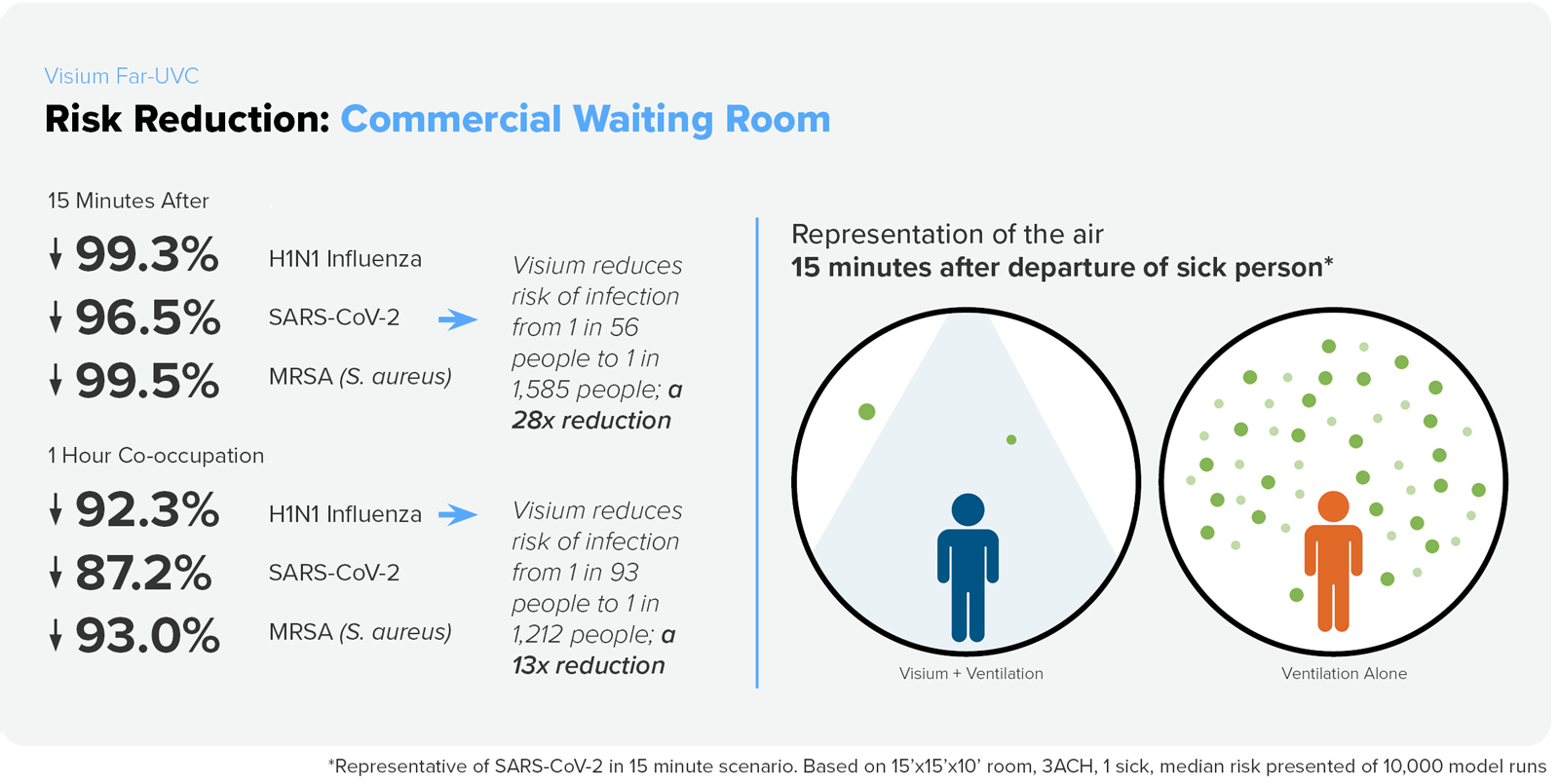
Waiting rooms at hospitals, clinics, and commercial storefronts are areas where sick and vulnerable people gather. They are known hot-spots where exposure could be from waiting alongside someone ill or waiting in the room after the sick person was called back for their appointment. Adding Visium to a waiting room can reduce the impact of these casual interactions and be an added layer of defense for staff.
Open Office Plans

Usually Lower Ventilation
8-hour co-occupation creates higher risk
Staff health is vital to productivity
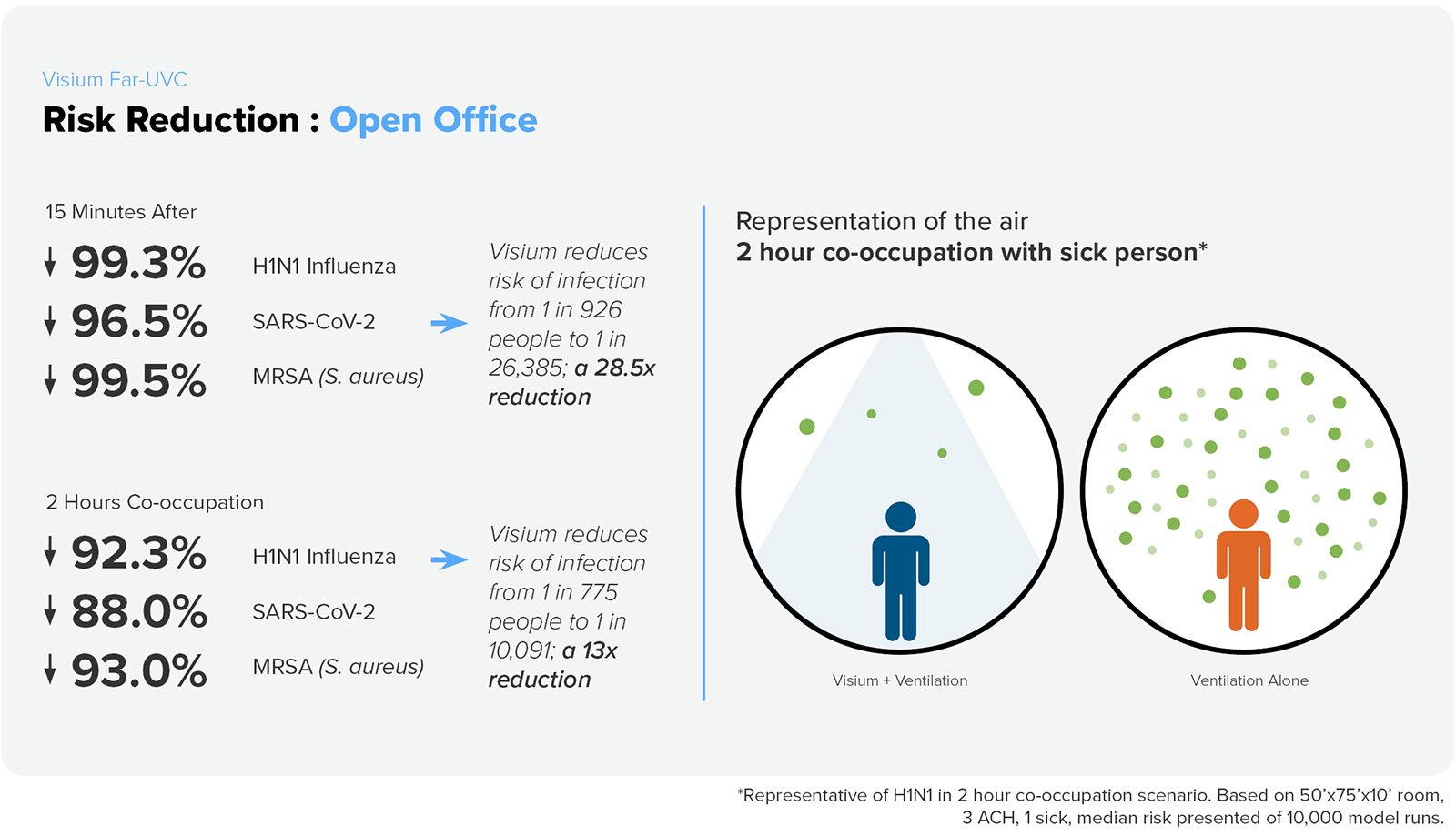
Offices are gathering places for sharing ideas and pathogens. A healthy work environment protects valuable staff and ensures high productivity with fewer downtimes. Far-UVC can help bridge gaps in ventilation and reduce pathogens floating in room air to improve air quality. As more workers return to the office, Visium can reduce risk from bioaerosols during times of seasonal illness.
Lecture Halls

High Person Density
Longer co-occupation times
Repeat classes means higher long-term risk
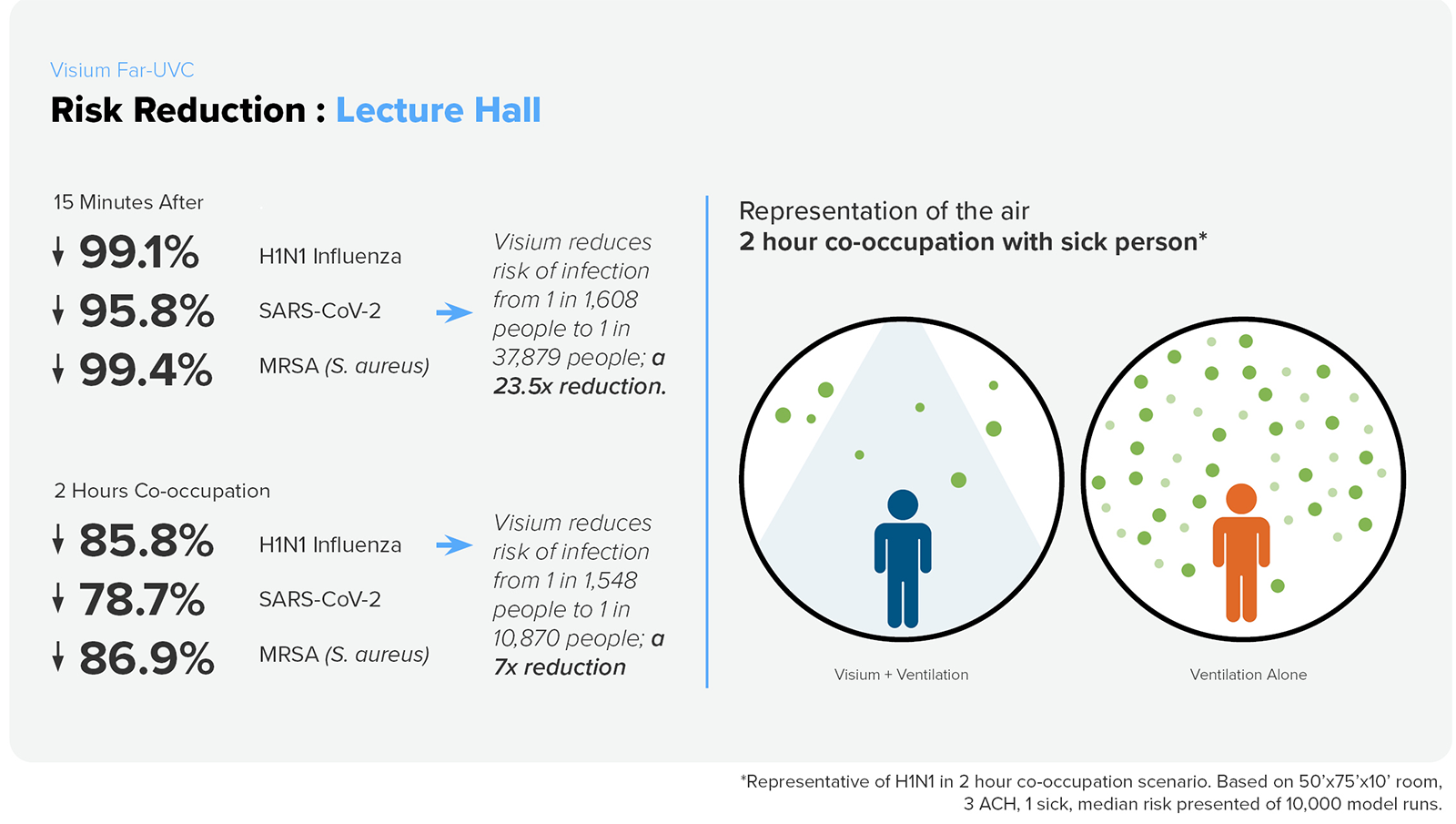
Large lecture halls gather people from all walks of life to share air and information for big classes and events. While the improved ventilation removes some pathogens, people are the greatest source of pathogens shed into the shared air of these facilities. These 1-2 hour long lectures mean increased risk to occupants as time progresses; even posing risk to the class in the room after the sick individual vacates. Visium Far-UVC reduces pathogen load in the air leading to reduced risk for students and staff.
Understanding Risk:
Change over time and in
relation to different scenarios
The risk of transmission changes based on many factors, including the pathogen, the space you’re in, and time. Not only does having a sick person stay in the same room for a longer time mean that pathogen is building up in the air, you as the healthy next host take more breaths in; increasing the number of potentially infectious particles to which you have been exposed. This means the longer you co-occupy a room with a sick person, the more likely you are to become infected.
The risk of transmission changes based on many factors, including the pathogen, the space you’re in, and time. Not only does having a sick person stay in the same room for a longer time mean that pathogen is building up in the air, you as the healthy next host take more breaths in; increasing the number of potentially infectious particles to which you have been exposed. This means the longer you co-occupy a room with a sick person, the more likely you are to become infected.
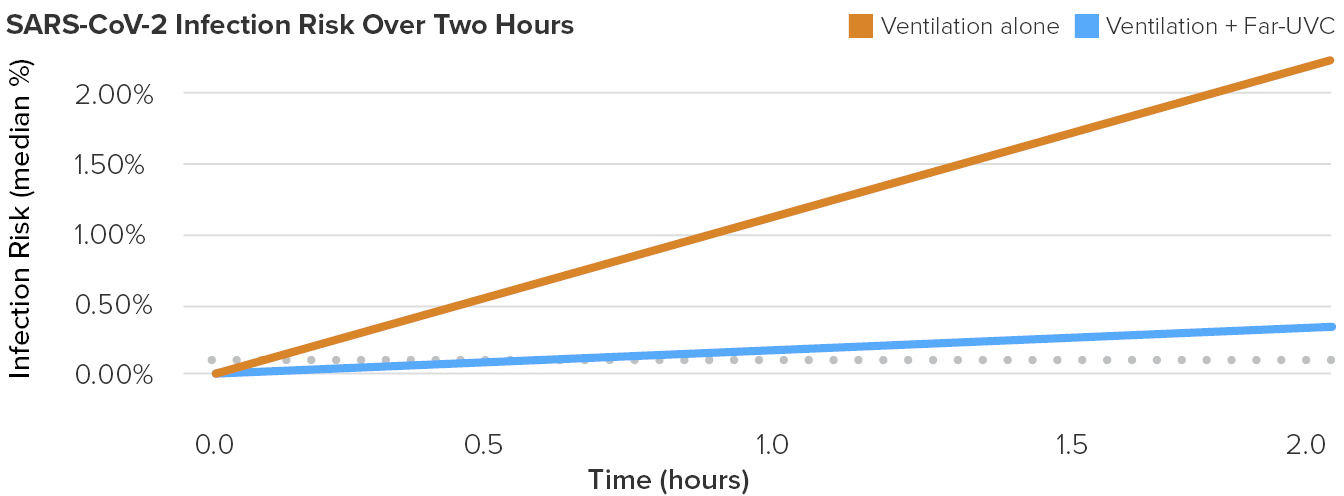
Every room or space changes the rate that transmission risk grows over time. Normally we intuit what situations are high risk. Such as a team meeting while a flu bug is going around or a preschool on any given day. We know these are places where we may be in contact with sickness, compared to a short elevator ride or a 1-on-1 meeting in an office where we feel reasonably assured risk is low. But we can use Wells-Riley and transmission risk for specific pathogens to understand relative risk in less clear scenarios we may find ourselves in. This allows us to decide whether adjustments to air quality, room capacity, or even personal plans should be made.
Visium Far-UVC isn’t just promising—it’s proven.
Across varied environments and scenarios, the technology delivers consistent, measurable reductions in airborne infection risk. Backed by rigorous modeling and peer-reviewed science, it offers a practical, effective layer of protection for real-world spaces. When health and safety matter most, Visium defines a new approach to managing invisible threats in real-world environments.
References
.
- Marr LC, Samet JM: Reducing Transmission of Airborne Respiratory Pathogens: A New Beginning as the COVID-19 Emergency Ends. Environ Health Perspect 2024, 132(5):55001.
- Blatchley ER, Brenner DJ, Claus H, Cowan TE, Linden KG, Liu Y, Mao T, Park S-J, Piper PJ, Simons RM et al: Far UV-C radiation: An emerging tool for pandemic control. Critical Reviews in Environmental Science and Technology 2023, 53(6):733-753.
- Eadie E, Hiwar W, Fletcher L, Tidswell E, O’Mahoney P, Buonanno M, Welch D, Adamson CS, Brenner DJ, Noakes C et al: Far-UVC (222 nm) efficiently inactivates an airborne pathogen in a room-sized chamber. Scientific reports 2022, 12(1):4373.
- Buonanno M, Kleiman NJ, Welch D, Hashmi R, Shuryak I, Brenner DJ: 222 nm far-UVC light markedly reduces the level of infectious airborne virus in an occupied room. Scientific reports 2024, 14(1):6722.
- Buonanno M, Welch D, Shuryak I, Brenner DJ: Far-UVC light (222 nm) efficiently and safely inactivates airborne human coronaviruses. Scientific reports 2020, 10(1):10285
- Welch D, Buonanno M, Grilj V, Shuryak I, Crickmore C, Bigelow AW, Randers-Pehrson G, Johnson GW, Brenner DJ: Far-UVC light: A new tool to control the spread of airborne-mediated microbial diseases. Scientific reports 2018, 8(1):2752.
- Tucciarone CM, Cecchinato M, Vianello L, Simi G, Borsato E, Silvestrin L, Giorato M, Salata C, Morandin M, Greggio E et al: Evaluation of UVC Excimer Lamp (222 nm) Efficacy for Coronavirus Inactivation in an Animal Model. Viruses 2022, 14(9).
- Li P, Koziel JA, Zimmerman JJ, Zhang J, Cheng T-Y, Yim-Im W, Jenks WS, Lee M, Chen B, Hoff SJ: Mitigation of Airborne PRRSV Transmission with UV Light Treatment: Proof-of-Concept. Agriculture 2021, 11(3):259.
- Noakes CJ, Beggs CB, Sleigh PA, Kerr KG: Modelling the transmission of airborne infections in enclosed spaces. Epidemiology and Infection 2006, 134(5):1082-1091.
- Norman A, K.A. Reynolds, C.P. Gerb: Determination of Infection Risk Reduction with an Overhead Far UV Light Device. Final Study Report. University of Arizona; 2025.
Partner With Us
We are actively working with new facilities that want to understand what continuous sanitization can do in their own environment.
If your organization is exploring ways to improve indoor environmental quality and reduce pathogen risk, we welcome the opportunity to collaborate. Our team will assess your space, recommend an appropriate Visium solution, and support your deployment to help generate real world results tailored to your facility.