
Use Cases by Industry
Agriculture & Food Production
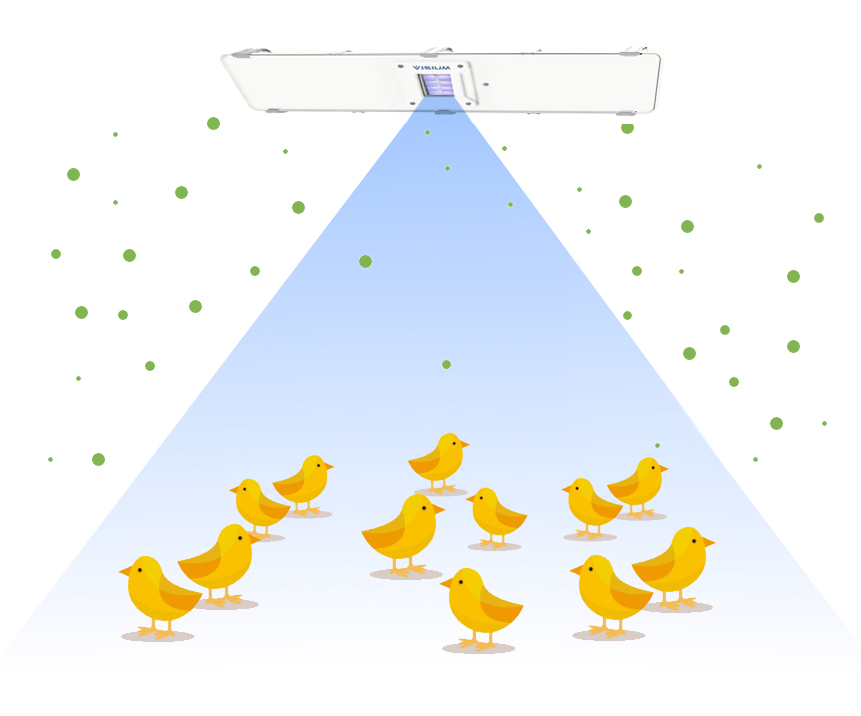
Visium improves biosecurity of farms using continuous, automated air and surface sanitization.
Visium Far-UVC
Continuous Environmental Sanitization.
Farmers work tirelessly to protect their facilities from external pathogens and maintain optimal health of their animals and crops. While billions are spent annually in preventative measures like filtration with varying success, the increasing prevalence of diseases such as Porcine Reproductive and Respiratory Syndrome (PRRS), African Swine Fever (ASF), and highly pathogenic Avian Influenza (HPAI) highlight the need for additional solutions.
In China in 2019, ASF resulted in over $100 billion in losses and nearly 1% of GDP loss. Here in the US, PRRS accounts for over $1+ billion in annual losses. And HPAI is estimated to have cost poultry producers $1.1 billion since 2020 according to the USDA. Far-UVC technology, with its ability to inactivate pathogens in human and animal occupied spaces can dramatically improve biosecurity.
Independent farm owners and facility managers employ layered defenses against pathogens, and constantly maintain HVAC, filters, and extensive cleaning practices to improve the animals’ or crops’ growth environment. Despite these measures, pathogen ingress through air or human error occur.
Visium technology offers continuous sanitization, adding a new defense against external pathogen sources and improving indoor air cleanliness dramatically.
Agriculture & Food Production
Use Cases
Entrances

Farrowing Barns
Laying Coops
QC Rooms
Common Areas

Visium Provides
Peace of Mind
Unhealthy indoor air environments impact everyone. Investing in indoor health is investing in our employees, our animals, and our communities. Government, educational institutions, healthcare, businesses, and building owners now recognize the critical importance of indoor air quality.
While upgrades to the HVAC systems may help, additional measures, such as adding Far-UVC solutions, may be required to improve our indoor air environment.
The utilization of human-safe Far-UVC is the perfect investment. Research shows dramatic improvements in the sanitization of buildings with insufficient ventilation and high traffic areas when Far-UVC is deployed.
The Importance of
Air Changes
Air changes per hour (or ACH) is how many times the volume of air in a room is replaced through ventilation.
High ACH is a common way to determine how healthy a room is or how clean the air is within an enclosed space. The air is replaced and therefore removes potential pathogens, lowering the risk to animals or occupants. In agricultural facilities like a swine or a poultry barn, the increased ventilation is aimed to remove gases like CO2, as well as to temper the environment. But this additional ventilation comes with the threat of pathogens from the outside air being brought in, posing a separate risk. Utilizing solutions, such as Far-UVC, with continuous air sanitization creates additional equivalent air changes per hour (eACH) to reduce the increased risk from airborne pathogens without bringing in air.
Balancing ACH and the risk from external pathogens allows facilities to keep their spaces safe and clean.


Modern Cleaning for High eACH
With Far-UVC
Effective use of air changes removes particles from the air and replaces it with clean air so that only a fraction remains after an hour. In areas of insufficient ventilation, not enough air is changed to effectively remove airborne contaminants and pathogens. Additionally, in high density areas like barns, infectious particles are constantly being introduced into the air from animals. In these instances, adding filtration, or UV lights increases air cleaning rates. Because these methods do not necessarily change the flow of air into the room, the cleaning efficiency of these methods are often quantified using equivalent air changes per hour (eACH).
The addition of Far-UVC sanitization solution can provide over 184 eACH (Eadie et al, 2022), sanitizing even the most populated facilities or least ventilated rooms.
A New Way to Clean
Clean Air at Light Speed
Visium uses 222nm Far-UVC technology to sanitize your facilities continuously, adding a new lay of biosecurity defense against pathogens.

Visium in Action
Ag & Food Production Case Studies
Fighting PRRS and Lowering Disease Risk for Sows at Mogler’s Pig Hill Farms
The Mogler family’s Pig Hill Farms West site is a critical hub of pig production within their breeding operation, housing the majority of their sows. As a key layer in the farm’s ever-evolving biosecurity and biocontainment strategy, Visium Far-UVC adds protection for the herd within the herd, functioning as an additional barrier alongside filtration to reduce the risk of airborne threats.
Using the Science of Far-UVC to Safeguard a Vital Food Source
The Egg Basket’s egg processing facility is pivotal in their production of farm fresh eggs to their ever-expanding distribution base within the central US. As an addition to the farm’s food safety and biosecurity protocols, Visium Far-UVC adds protection against pathogens introduced through harvesting as well as providing an additional barrier to reduce the risk of environmental threats such as Salmonella and Campylobacter.
Enhancing Biosecurity for Turkey Flocks at Zimmerman Farms
The Zimmerman Farms’ brooder barn is a critical hub of their turkey operation, housing the poult production. As a component of the farm’s ever-evolving biosecurity and biocontainment strategy, Visium Far -UVC adds protection for the young flocks cycling through, functioning as an additional barrier to reduce the risk of airborne threats such as Influenza and Metapneumovirus.