
Science Overview
The Evolution of UV-C
UV-C: The origin of germicidal ultraviolet light
Most people are familiar with ultraviolet light as UV-A and UV-B, the wavelengths produced by the sun. What is less well known is UV-C, a shorter wavelength that never reaches the earth’s surface because it is blocked by the ozone layer.
For more than 100 years, scientists have been producing UV-C artificially through specialized lamps and using it to inactivate pathogens in water, in the air, and on surfaces. Because of this germ-killing power, UV-C is often called germicidal UV.
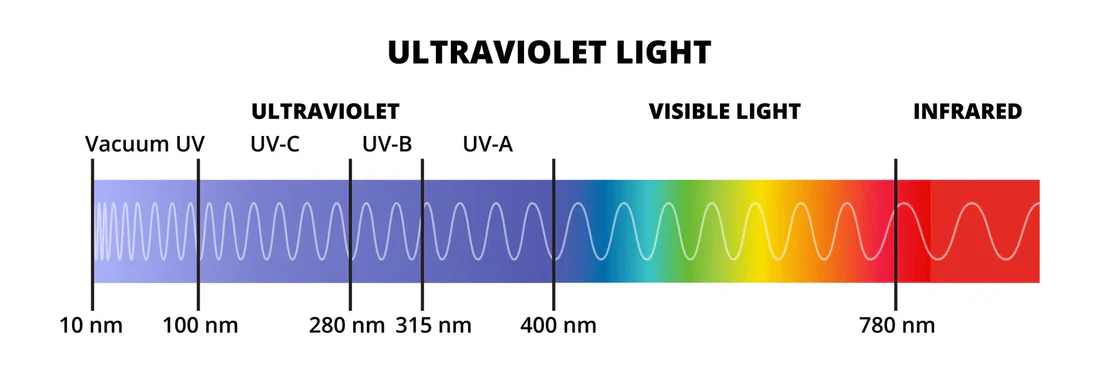
All wavelengths within the UV-C spectrum (200–280 nm) are capable of inactivating pathogens. But at the lower end of the spectrum, below 230 nm, science shows a unique advantage: the light cannot penetrate the outer dead layer of the skin (the stratum corneum) or the tear layer of the eye. This discovery opened the door for safe, continuous use of germicidal UV in occupied spaces, ushering in the era of Far-UVC at 222 nm.
Far-UVC
Safe for Eyes & Skin
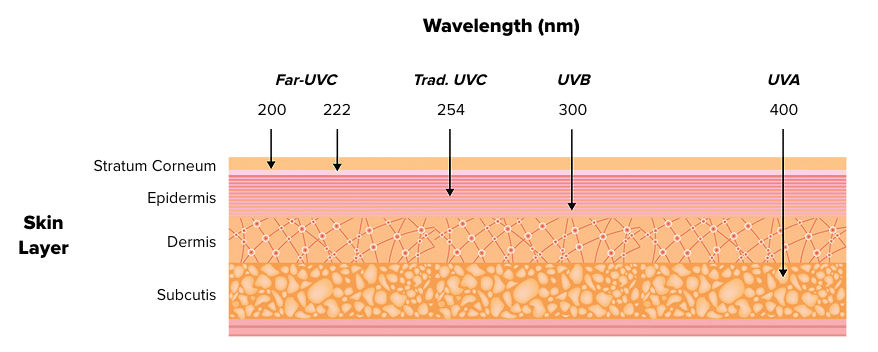
The safety of UV light on skin is dependent on the wavelength and light intensity. The more UV light you receive, the greater the risk of skin damage. But this risk is proportional to the wavelength of the UV light as well. The shorter the wavelength, the safer for human skin. This is because shorter wavelengths do not travel through skin as well as long wavelengths.
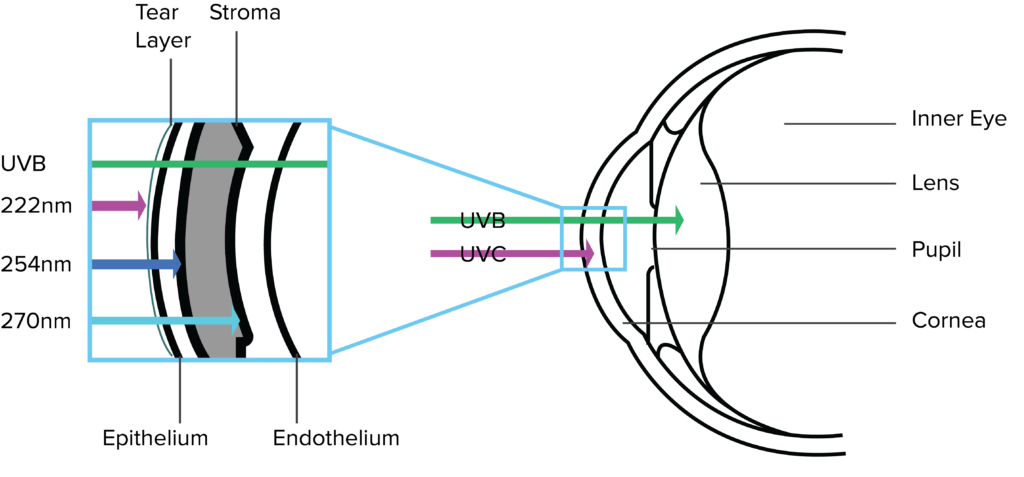
Far-UVC, a shorter wavelength of ultraviolet, is unable to penetrate the superficial layer of our eyes or the dead skin layer (also called the Stratum Corneum). Far-UVC is scattered or absorbed by these peripheral, shedding layers and shield the living tissue below. Because of this protection, Far-UVC does not pose a risk when applied following manufacturer instructions. This difference allows for greater ability to clean occupied spaces.
Today, most UV cleaning systems are contained in air ducts, within boxes, used only in unoccupied spaces, or are shined at ceilings so that the higher, cheaper to produce wavelengths can be used. Small spaces such as bathrooms and elevators are difficult to clean due to lack of airflow, renewing pathogen sources, and concerning surface contamination. Far-UVC applications are the ideal solution for these difficult, insufficiently ventilated, high traffic spaces.
Far-UVC Light
Effectiveness
Unlike traditional cleaners which depend on causing oxidative stress or damaging membranes leaving them ineffective against some viruses and spores, UV light targets the DNA or RNA of cells and viruses to provide a cleaning effect. Because of this, UV light is effective against bacteria, viruses, fungi, protists, algae, and spores. With UV light, pathogens can be reduced by 99.9% repeatedly in a time and cost effective manner [2].
Independent Visium testing demonstrate up to 99.9% effectiveness against a broad range of pathogens. See the data here.
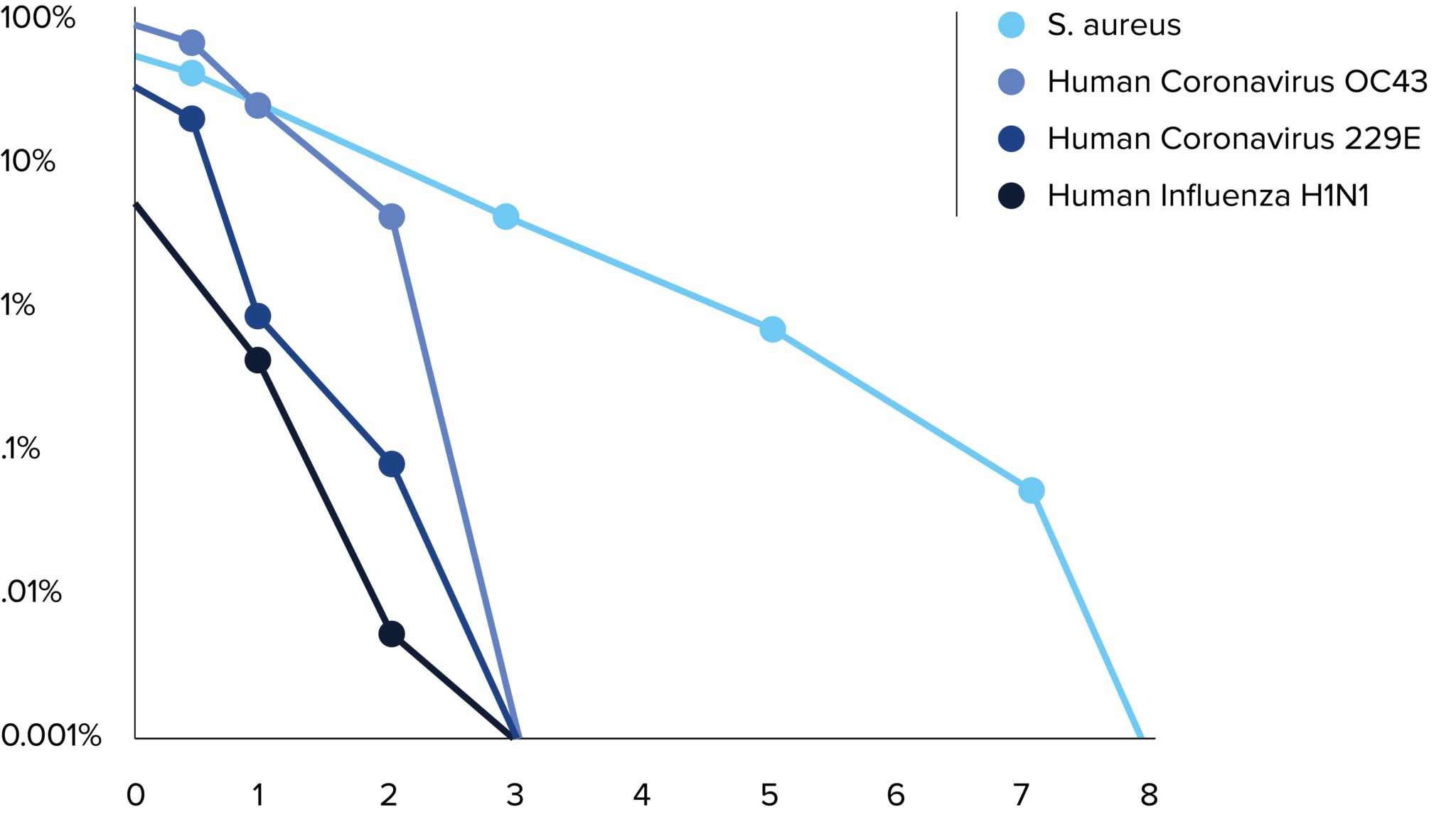
Dose (Unit: mJ/cm²) — [1]
Why We Need
Far-UVC Light
Far-UVC light is able to kill bacteria, viruses, molds, and spores in the same fashion as traditional UVGI. Far-UVC and traditional UVC cleans all the air exposed to the light, dramatically increasing the air cleanliness of our shared spaces. The greatest advantage of Far-UVC is the ability to shine its light downwards in occupied rooms safely.
Numerous research studies show Far-UVC is as effective at inactivating infectious contaminants as traditional UVC, without the health risk to skin and eyes. By introducing Visium to any existing mitigation process, indoor air can be cleaned more rapidly and efficiently without risk of harm to occupants as verified by UL 8802 testing.
Citations
1) Far UVC Efficacy Example – Eadie, E., Hiwar, W., Fletcher, L. et al. Far-UVC (222 nm) efficiently inactivates an airborne pathogen in a room-sized chamber. Sci Rep 12, 4373 (2022). https://doi.org/10.1038/s41598-022-08462-
2) Far UVC Efficacy and Safety- Hessling, M., Haag, R., Sieber, N., and Vatter, P. (2021). The impact of far-UVC radiation (200-230 nm) on pathogens, cells, skin, and eyes – a collection and analysis of a hundred years of data. GMS hygiene and infection control, 16, Doc07. https://doi.org/10.3205/dgkh000378
Neutralizing Airborne Risks with the Power of Light.
Clean, quiet, and chemical-free, Visium will continuously and safely eliminate harmful indoor pathogens using the power of Far-UVC light.
THE SCIENCE OF FAR-UVC
Academic Research
Far-UVC is Supported by a Robust and
Growing Body of Peer-Reviewed Science
Inactivates Pathogens in the Air
Far-UVC can continuously inactivate viruses and bacteria in indoor air including influenza, SARS-CoV-2 surrogates, and multidrug-resistant organisms in occupied spaces.
Studies: 10+
Inactivates Pathogens on Surfaces
Far-UVC actively reduces bacterial and viral loads on high-touch surfaces, supporting continuous environmental cleaning alongside manual cleaning practices.
Pivotal Studies: 25+
Human & Animal Safety Studies
Characterization of Far-UVC interaction with skin, eyes, and the environment suppports use in occupied spaces within ACGIH guidelines.
Pivotal Studies: 35+
Real-World Applications & Results
Clinical research in hospitals, restaurants, classrooms, and other settings demonstrates pathogen reduction and safety under real-world occupancy and workflows.
Pivotal Studies: 10+
To view Academic Research related to Superconductor LED research, please visit the Visium UltraLabs page.
THE SCIENCE OF FAR-UVC
Far-UVC Reduces Airborne Pathogens
2023
Far-UVC: Technology Update with an Untapped Potential to Mitigate Airborne Infections
Bueno de Mesquita et al.
2023
Air and Surface Treatment Using Germicidal Ultraviolet-C (GUV)
Claus & Clark
THE SCIENCE OF FAR-UVC
Far-UVC Inactivates Pathogens on Surfaces
2023
Antimicrobial Activity of Filtered Far-UVC Light (222 nm) against Different Pathogens
Lorenzo-Leal et al.
THE SCIENCE OF FAR-UVC
Demonstrated Safety for Human Exposure
2023
Far UV-C radiation: An emerging tool for pandemic control
Blatchley et al.
THE SCIENCE OF FAR-UVC
Healthcare & Real-World Outcomes
2023
Indoor Air Quality Implications of Germicidal 222 nm Light
Barber et al.
2023
Antimicrobial Activity of Filtered Far-UVC Light (222 nm) against Different Pathogens
Lorenzo-Leal et al.
2023
Far-UVC: Technology Update with an Untapped Potential to Mitigate Airborne Infections
Bueno de Mesquita et al.